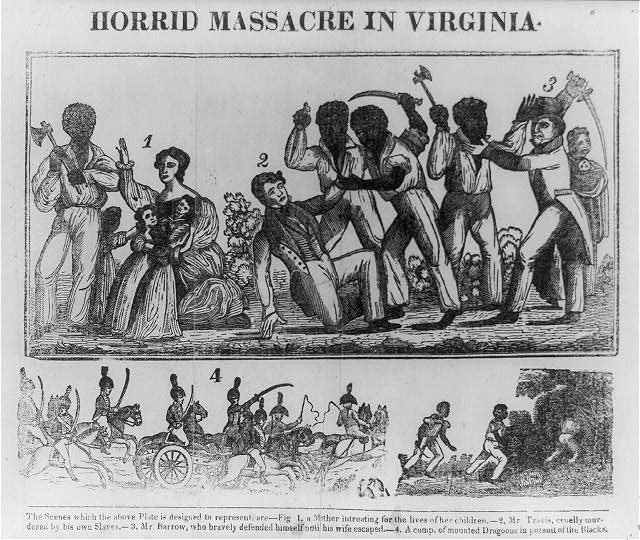
I‘ve been thinking quite a bit about the images of slave rebellions and miscegenation that shaped the world view of white Southerners throughout the antebellum period. In the case of Nat Turner’s Rebellion newspapers throughout Virginia and beyond offered extensive coverage and attempted to offer an explanation that would assuage the concerns of what white Southerners believed to be docile and loyal slaves. However, even before the bloody events that transpired in Southampton County, Virginia in August 1831 there had already been close coverage of slave insurrections in the broader “Atlantic World” that stretched back to the rebellion in Saint Domingue. In fact, by 1831 explanations purporting to explain why their slaves might rebel had already been strongly embedded by subsequent rebellions in Demerera, Barbados, and elsewhere. The explanation that abolitionists (Missionaries) were responsible for the violence on their plantations provided a ready-made answer for Southern slaveowners who pointed the finger at the small abolitionist community in Boston. Such an explanation, however, makes little sense without a broader appreciation of how events throughout the Atlantic World shaped their outlook. Indeed, as historian Edward Rugemer asserts in his excellent study, The Problem of Emancipation: The Caribbean Roots of the Civil War, explanations of Turner’s Rebellion take on a hysterical quality. He notes that by the time of the insurrection William Lloyd Garrison’s Liberator had only recently begun publication, though its circulation was quite limited, The American Anti-Slavery Society had not yet been formed, the “Declaration of Sentiments” had not been written, and the New England Anti-Slavery Society had not even published its second Annual Report. Finally, many northern newspapers condemned the violence in Virginia.
A few months after Turner’s Rebellion a much larger insurrection in Jamaica (“Baptist War”) involving 60,000 slaves broke out. This was followed by England’s decision to abolish slavery in the West Indies. My point is that to understand the fears of white Southerners (slaveowner and nonslaveowners alike) we have to consider the few rebellions that took place throughout the colonial and antebellum periods in a much broader context. Information flowed back and forth freely first through word of mouth in port cities and later via the printed word. White Southerners did not have to have seen the above woodcut, which was published in Authentic and Impartial Narrative of the Tragical Scene Which Was Witnessed in Southampton County to understand the dangers of insurrection or their role in preventing such a nightmare. By 1831 many white Southerners had come to view their world from a defensive posture which acknowledged the threat to slavery as stemming from ruthless abolitionists and a distant government.
William L. Garrison → Nat Turner → Jamaica → England abolishes slavery in West Indies → John Brown → Election of Republican Party → Emancipation Proclamation → Crater → ?
The men who joined the regiments that constituted the Virginia brigade of Mahone’s division at the Crater did not have to have seen the above woodcut because they lived it. All of the regiments were raised in the Richmond-Petersburg-Norfolk area and William Mahone was born and raised in Southampton County. The woodcut beautifully frames how we as historians should unpack/analyze how Confederates at the Crater viewed the presence of USCTs as well as how they responded.
Hi Kevin,
I have had a question concerning the use of black troops in the Civil War for quite some time. I am not certain that you can answer the question, but I would like to pose it, if I may.
Knowing (I assume) the hatred and fear that white southerners felt for black men and women, particularly for black men bearing arms, why did the Union employ black soldiers and put them in such danger? Are there comparison studies to other wars that can be done? For example, were Jewish soldiers put in the front lines to fight the Nazis? Why were black soldiers put in such terrible danger is my question. Also, was the Union high command aware of the unique dangers African American troops faced in the Civil War? What was the official policy? Thanks, Kevin. Sherree
Your posts bring up the valid point that slaveowning and nonslaveowning Southerners were united by a common fear of the rebellious black man attacking and destroying their places in society. Oppression becomes acceptable when the oppressors believe they are oppressed or in danger. For that reason, armed black Union soldiers were deemed such an affront and a threat.
Kevin,
Would you say the “threat” felt by southerners was that of fear of the change in the strata of their society, or more a fear of what retribution would look like?
Again, not to keep picking on a theme, but it seems to me there’s got to be more than a standard view point expressed by Southerners in their writings. Rather some range of sentiments on the issue. Particularly if you follow Genovese logic as to the interaction between the planter class and poor whites.
Craig.
Craig,
The evidence is pretty clear that Confederates in the ranks believed that black soldiers constituted a threat to their “way of life” and they also worried about retribution. Again, I think we need to connect these men to the antebellum culture of a slaveowning society. All too often we interpret Civil War soldiers in a vacuum as if they simply fell out of the sky in 1861. As I’ve said before I think the post-emancipation period (1863-65) helped to clarify for white Southerners just what was at stake in the war and may help to explain why they persisted for so long even after the point where, from our perspective, things looked bleak. In this context, I am thinking of Jason Phillips’s recent book _Diehard Confederates_, Chandra Manning’s _What This Cruel War Was Over_ and especially, Joe Glatthaar’s _General Lee’s Army_ who offers a convincing analysis that should help us think of the threat and defense of slavery as extending beyond a narrowly-defined slaveholding class.
As to your second point, what strikes me is the convergence that I am finding in the accounts of Confederates following the Crater on the perceived threat represented by black soldiers. The paternalism that Genovese analyzes comes through loud and clear in their insistence that slaves would never fight against their masters unless they were duped into doing so. Many accounts suggest that they were drunk or forced to fight. Your point about the interaction between the planter class and poor whites does come out in plenty of other areas, including questions of leadership and discipline in the ranks.
Interesting things to think about.
Just to muddle things up some…Southhampton County also produced another famous son; Union General George H. Thomas. Thomas of course employed a number of USCT regiments at the Battle of Nashville in December 1864 that basically put an end to the Confederate Army of Tennessee.
Two red pennies: there is a level of anxiety in slave societies. Peter Woods’ Black Majority about early South Carolina is a good look at that level of anxiousness on the part of whites in an area where slave populations were in the majority. Often a large plantation would fit this model – a few whites surrounded by numerous blacks – often out numbered by blacks.
Not only did Nat Turner strike in 1831 but in and around 1800-1802 there was a slave uprising scare, if not an actual uprising. In 1795 some white people in northeastern North Carolina petitioned against the Quaker policy of manumission/ emancipation. Strikingly the level of anxiety is obvious in the petition: the second half of the petition includes this list of concerns “havoc and massacres which have lately taken place in the West Indies in consequence of emancipation; knowing the opinion of the Northern states; of the many hundred thousand slaves around them; and of the infatuated enthusiasm of men calling themselves religious, who are amongst them.”
The many hundred thousand slaves around them is nowhere near accurate if we believe what we can prove about slaves in northeastern NC but the statement speaks to a level anxiety and animosity towards slaves. Within a few years this anxiety erupts into an investigation of an alleged slave uprising (May 1802) – but trial put such rumors to bed.
When freedmen were handed weapons and assigned garrison duty in Elizabeth City in late 1862-1863 local secessionists were fearful – and one woman’s fears published as an exert from her letter to her husband (who was in the CSA army) and what she dreaded most was the airs that the freedmen exhibited. The sight of these men with a gun was bad but that they carried themselves as men and expected to be treated as men was too much – being soldiers was a leveling of society and one that the white slave society could not let happen.
You can get change back from those pennies if you want.
The troops from Southampton would certainly be more sensitive to these issues, and that is to a great extent obvious. That black men with guns raised all sorts of horrific images is also obvious. I guess that is where I am with this. Now, to a lot of folks unschooled in Civil War history, none of this will be obvious, so if that is you audience, then I think you have a good thing going here.
Sorry to be so critical; it’s the end of the week, I guess I’m just in a bad mood 🙁
Please don’t apologize. I appreciate readers like you who force me to think more clearly.
I guess I’d like to see someone—one of the officers, say—make explicit reference to the Turner rebellion. Otherwise, I think your thesis is a bit of an exercise in the obvious: White Southerners would of course see black men with guns as threatening the very fabric of their society, and men from Southampton would be more sensitive than most. (So would folks from Chaleston.) I’m not meaning to be ugly-critical. You also have to examine, as Brooks suggested, how the events in September at New Market Heights and Fort Gilmer play into this.
I wish you luck, in all seriousness.
James,
I don’t see why they would have to reference Turner specifically to make the broader point that their words and actions mirror those exhibited when black slaves proved to be a threat during the antebellum period. It would have been understood. Let me be clear that I believe white Southerners generally would have viewed what happened at the Crater and elsewhere as something that reminded them of the dangers of emancipation, race war, miscegenation, etc.
While it may be “obvious” to understand the presence of black soldiers as a threat that doesn’t help us to understand that threat. I want to better understand why it was a threat. Why, for instance, was it necessary to mix the black and white Union prisoners and march (and countermarch) them through the streets of Petersburg? Why were large numbers of blacks executed after the battle. You can’t simply say that they were a threat since threats can be dealt with in any number of ways.
Thanks again for your comments on this.
Kevin,
I assume your line of reasoning is NOT that all white Southerners were afraid of black men in arms, but rather that a particular segment of Southern society was. If so would you care to elaborate as how we might better define that segment (pro-Confederate or non-unionist would likely not be fully inclusive, I’d submit)?
An interesting aspect then would be to relate the rational differences between Southerners who did voice concern/or in other ways feared the arming of blacks AND those that didn’t hold such fears. Might be difficult to extract, but such would go straight to the heart of the larger issue of racism in the South.
On the flip side of this, I’ve got to ask if Southerners were so afraid of armed blacks in blue uniforms, then how did they feel about those “tens of thousands” of armed black Confederates?
Craig,
Great questions. Of course I am not suggesting that all white Southerners believed anything. Unfortunately, I don’t think I can be of much help with trying to break down specific segment of society within the Confederacy or the South as a whole. My main points in this project are based on the collection of a great deal of archival collections, including letters, diaries, and newspapers. The units who were present at the Crater came from various parts of the South and tend to express the same fears and, of course, anger/rage at having to fight black Union soldiers. Whether the Army of Northern Virginia can be considered a cross section of society is something that can be debated, but I am at least comfortable in asserting that these views were representative of the army. Scores of newspaper accounts reinforce many of these points on the home front.
I honestly don’t know how I would go about trying to more clearly discriminate between different segments of Southern society. Much of my understanding of the question of race in the antebellum South comes from studies by Ira Berlin, Thavolia Glymph, Eugene Genovese, and Peter Kolchin – to name just a few.
I did read the earlier post. I think you have embarked on an interesting thesis here, and I don’t mean to be overly critical, I just think you are going to have a difficult time nailing it down. The men from Southampton County would certainly have been more “sensitive” to the presence of black troops in their front. I’m just dubious that you are going to be able to get where you seem to want to go. I certainly wish you luck. Question: Was Willie Pegram from the Southampton area?
Pegram was born in Richmond and was a student at the University of Virginia on the eve of the Civil War.
I guess I am not quite sure what you think I need to nail down. The battles of Olustee and Miliken’s Bend only help to make my point. It’s one thing to cite Confederate rage, but that in and of itself isn’t an explanation. We want to better understand what it meant for white Southerners to see black men with weapons and directly threatening the white population of Petersburg and white society generally. It’s a cultural point about meaning. Again, former slaves (yes, I know that not all of them were former slaves) with guns would have meant something based on their understanding of slave insurrections in Virginia and elsewhere. Their perceptions did not exist in a vacuum.
This is an interesting take on what happened at the Crater, but I am not sure you have made your case. Mahone’s men would have reacted angrily at the presence of black troops opposed to them even if Nat Turner never happened, or even if they (Mahone’s men) were from a different part of the South. Other Confederate formations executed USCT prisoners after battles (Olustee and Miliken’s Bend come to mind). ISTM you need to find some evidence that they saw the presence of Ferraro’s men as some kind of “Nat Turner redux” event. Sorry for being negative.
Hi James,
First, I’m not sure you’ve read the previous post on this in which I lay out my interpretation in a bit more detail. http://cwmemory.com/2009/06/16/was-the-battle-of-the-crater-the-last-slave-insurrection-in-the-western-hemisphere/ As I mentioned in a later post I am currently working on fleshing this idea out for one of the Civil War magazines. So, admittedly this is a work-in-progress.
As to your comment I agree that white Southerners generally would have viewed the presence of blacks at the Crater as a slave insurrection. And I am not suggesting that the men in Mahone’s Virginia brigade or any other unit were actually thinking about Turner as they went into battle. I am making an argument about the culture of a slave society that worried a great deal about the maintenance of a slave system. Turner stands out because it was the most violent slave insurrection and it stands to reason that given the proximity in which the units were raised that many of these men would have heard stories throughout their lives. No doubt, they would have heard stories from many quarters. That said, beyond Turner specifically we need to acknowledge that white Southerners understood their roles and responsibilities in maintaining a slave society. As far as I can tell the letters and diaries of Confederates along with newspapers reveal a language that can only make sense if we connect to a bigger history.
I agree with you Kevin; the Civil War and the Crater did not happen in a vacuum. All these previous events played a role in what happened at the Crater.