 I‘ve said more than once that I find Civil War memoirs to be very difficult to use when trying to understand the war itself. Many are self serving and are inevitably influenced by the political, social, and economic conditions present at the time of writing. While difficult to use to illuminate the war itself, I enjoy trying to piece together an analysis that places the source in its proper context. One thing I’ve learned after years of research on the memory of the Crater is that nothing written by former Confederates and other Southern commentators after 1879 can be understood apart from the radical political changes that William Mahone introduced to the state and the lingering bitterness and suspicion that would be attached to his reputation well into the twentieth century.
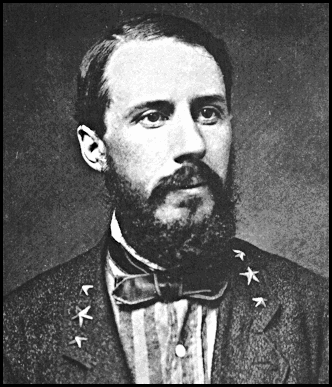
That said, we can identify those postwar sources that seem to transcend the influences mentioned above. Please don’t ask me to explain how we can identify these specific sources; suffice it to say, we just know – think “Brewmaster’s Nose.” There is a sense that the author is attempting to be fair and balanced; he is self-effacing and may even accept blame on occasion. I can’t think of a better example of such a narrative than Edward Porter Alexander’s Fighting for the Confederacy, which was edited by Gary Gallagher back in 1989. It’s the gift that keeps on giving. There are very few memoirs that top 500 pages that I can claim to have read in their entirety, but I can honestly say that I’ve read it through twice and large sections multiple times. In contrast with Military Memoirs of a Confederate (1907), Fighting for the Confederacy was written for his grandchildren and, if I remember correctly, was written while in Nicaragua. No doubt, this helped to shape the narrative.
Recently, I decided to go back and reread Alexander’s chapter on the Crater as I finish up my essay on understanding the post-battle massacre of USCTs as a slave rebellion. It should come as no surprise that nothing I’ve read in the letters and diaries of Confederates who were at the Crater describe it as a slave rebellion or reference the likes of John Brown and Nat Turner, so you can imagine my surprise when I came across the following:
In fact there were, comparatively, very few Negro prisoners taken that day. It was the first occasion on which any of the Army of Northern Virginia came in contact with Negro troops, & the general feeling of the men toward their employment was very bitter. The sympathy of the North for John Brown’s memory was taken for proof of a desire that our slaves should rise in a servile insurrection & massacre throughout the South, & the enlistment of Negro troops was regarded as advertisement of that desire & encouragement of the idea to the Negro. (p. 462)
This was not the first time that I read this passage and I’ve even used it in different places in the manuscript, but reading it again as I think about slave rebellions, John Brown, etc. gives it a salience that I failed to fully appreciate.
I ran across an old copy of this (probaby a first edition from 1989) on an old bookshelf of CW books that a member of the Civil War Trust gave me when he cleaned out his garage. It must not have grabbed my attention at age 15, since I appearantely shelved it for 10 years.
So, the first thing I thought was “oh, maybe this has camp life descriptions.” And I threw it on the stack with the Winston Churchill autobiography volume I had originally come looking for. But curiosity overtook me, and I opened Alexander’s book. When I opened it, I noticed that it was arranged by battles. So of course the first thing I looked for was Petersburg. Then I saw a painting of the crater. And then I read the pages. And then my brain exploded.
I always thought that Crater research was something guys like you did in obscure University libraries reading plastic-covered copies of handwritten letters from obscure individials. I never expected to find a published biography by an actual Confederate that described everything so bluntly and succinctly. I just didn’t ever expect a period account like this to exist.
I figured you had written about this, so I searched CWMemory and found this page. Since yesterday, I have read about 200 pages in this book (a record for me, since I’m usually super-ADHD and only read in sporatic bursts).
If anyone out there is interested, Petersburg National Battlefield will be having a series of talks, tours, and living history demonstrations in honor of the 145th Anniversary of the Crater on August 1st & 2nd. It ain’t Amsterdam, but…
Kevin,
Did you know Don Bloom when you were at ASMS? He was a TA in the English department where I finished my undergrad and attended grad school.
Its quite interesting to me to see that Mobile played a role in shaping your perception of the South. My great great grandfather died from the Yellow Fever he acquired in the swamps following the Battle of Spanish Fort. Ive been puzzled for some time by how incidental the fall of Mobile has been in the prevailing narrative of the war. Is the fall of Mobile related in some way to your concern about Southern perceptions of black soldiers as participants in a slave insurrection?
Kevin,
While
the USCT members felt they were fighting against slavery, the way they were fighting was not encouraging revolutions, or enabling slave revolts, they were fighting the armed forces of the Confederacy as conventional troops.
The Union government never pursued a policy of, for example, sending spies or arms to blacks on Southern Plantations, to spark armed resistance, among slaves.
Confederate troops at the Crater and elsewhere may have seen servile insurrection, as the period phrase goes, but it was a script in their own heads. The paradigm among the USCTs was more like, you had to leave slavery, be transformed into a soldier, and then fight the Confederate army on de clar field, both to end slavery and become citizens.