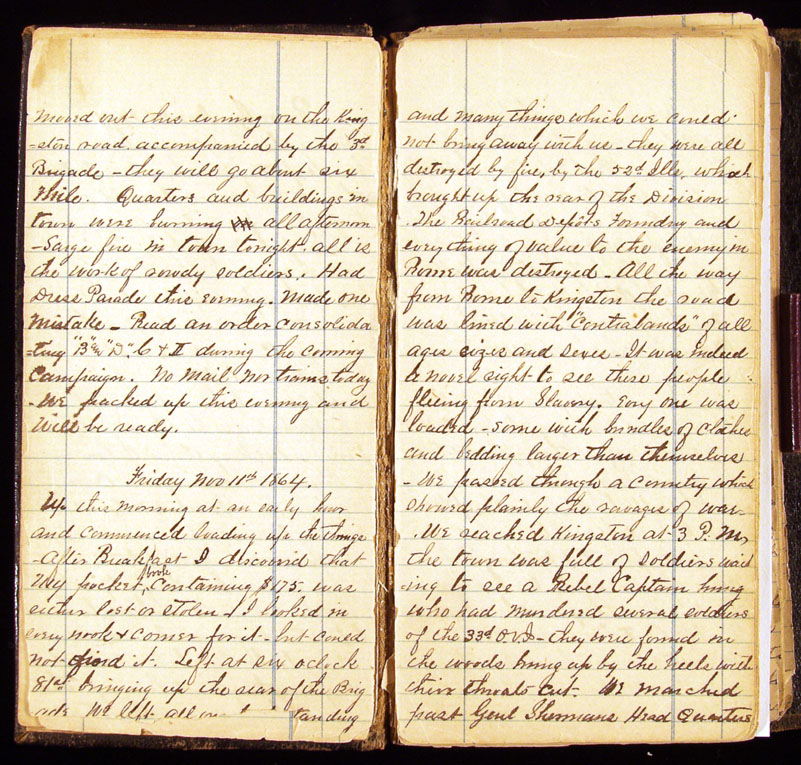
 This last trimester I am working closely with a very talented senior, who is experimenting with historical fiction set during the Civil War. The story is set in Virginia and told through the eyes of a young Virginia girl. We decided that it might be helpful to base the story on some primary sources so today the two of us headed on over to the Special Collections Department at the University of Virginia. We decided to take a look at Sara Ann Graves Strickler’s wartime diary, which is incredibly rich. I’ve known about the diary for some time, but this was my first opportunity to read it for myself. It was a real treat having the opportunity to share that inexpressible joy that comes with holding an important piece of history. As I like to say, in those brief moments time collapses. We took turns reading random entries to one another and looking to see if Sara addressed specific events during the war. Diaries such as Sara’s get us up close to individual lives and force us to confront the contingency that defined their lives and many of the same hopes, dreams, and fears that animate our own. For my student that connection was reinforced in a shared interest in the French language and literature, the references of which were sprinkled throughout the diary.
What I Will Miss
Civil War Memory has moved to Substack! Don’t miss a single post. Subscribe below.
I always felt that historical fiction novels are an extremely useful teaching tool. They engage the readers with characters similar to themselves while also teaching the history itself- the historical fiction novels that I read as a child were actually what got me interested in the study of history. Historical fiction also reminds us that Its important to emphasize the connecting factors between the people of the past and the people of the present: its easy to forget that these old names on a page were in fact people who had emotions, troubles and interests just like us. Diaries such as these and the stories found in historical fiction reinforce this notion and help us remember.
Hello Kevin,
Your joy at holding a piece of history in your hands struck a responsive chord with me. Some years ago I felt the same when I discovered the dozens of letters my great grandfather had written from 1850 through 1880. I was equally thrilled when I discovered the diary of Lucy Breckinridge of Grove Hill, especially because my ancestor was the Lt Richardson who made such a big impression on Lucy: editor Mary Robertson had not identified him because she didn’t check the staff officers – he was Engineering officer for Early and Ewell. I suppose these moments were what led me to start writing his biography, a book which is almost finished. (I would be honored to see my new book blog on your blog roll.)
I recall from an earlier post that you are about to move to Boston. Obviously, it will be hard for you to leave Virginia, but there is surely some consolation for you in knowing what rich historical resources await you in the Boston area. I have had the pleasure of using many of the depositories there myself, because my ancestor was a New Englander who fought for the South. I wish you a non-stressful move (if such is possible). Don’t lose any precious papers and enjoy your new historical area.
Thanks for the kind words, Farrar. I still get excited when working with archival material, but I especially enjoy sharing that joy with my students. As for the move, things are beginning to come together, but it is a stressful process.
I am really looking forward to exploring the rich history of Boston.