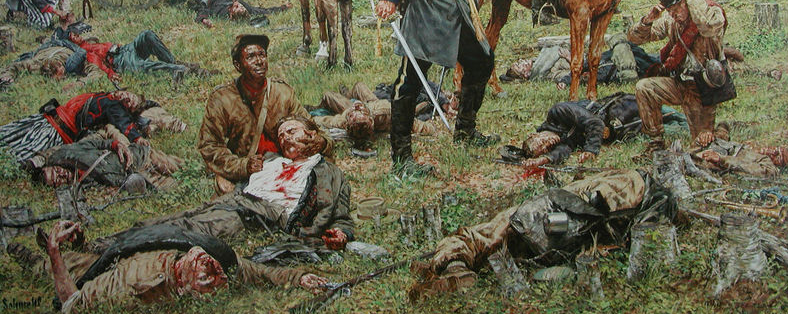
 I am close to finishing up a magazine article on Confederate camp servants. This morning I read through a number of postwar accounts, which are always tricky to interpret. Consider the following passage from Andrew Ward’s, The Slaves’ War: The Civil War in the Words of Former Slaves
After the war, a slave named Luke would ask for a parole when his master, a Confederate colonel, surrendered to a Yankee officer in Columbia, Mississippi. “Luke, you don’t need one,” said his master. “You never been a soldier.” “Yes, I has been a soldier–for four years,” Luke replied. “Now you and that man don’t want to do me that way.” The Yankee officer declared that Luke “made more sense” than the colonel did, and gave him his parole.
There is quite a bit to unpack here. First, there is Luke who is passionately making his case for recognition as a soldier. It’s not simply the status he is interested in, but the respect and acknowledgment that he had suffered and exercised the same virtues as any other man in the army. Luke is also quite assertive in his sharp response to his master and plea that he ought to be accorded the status of soldier. It’s hard not to see such a strong defiance as a product of his four years with the army, including some experience on the battlefield.
Luke’s master’s response speaks for itself. He was and is not a soldier in the Confederate army. Such an acknowledgment would have rendered the two as equals. Slaves could not be seen as exhibiting the same martial virtues and at the same time continue to be seen as the legal extension of the master’s will. Recognition as a solider also collapses the distinction between slave and citizen. The service of soldiers was a function of their obligation to the state as citizens. Slaves served their masters.
Finally, what are we to make of the Yankee officer’s decision to grant Luke a parole? On the one hand, it is very possible that he sympathized with the slave and believed he had made his case for the official recognition. I prefer a different interpretation. That officer would have understood what that military document meant to Luke’s master. In granting the parole he did something worse than acknowledge Luke’s freedom. He acknowledged Luke as his master’s equal.
I would think the context of this “memory” would aid its interpretation. Who recalled this incident and how long after 1865 was it recorded?
That Union officer not only acknowledged Lukes service which his master wanted to deny in order to continue to suppres him he also understood what the future should hold.
“Bottom rail now on top now, massa”
Kevin,
I would agree with your interpretation of the Yankee officer giving Luke his parole.
“Bottom rail on top this time mater, bottom rail on top!”
I don’t believe that quote accurately reflects what took place. The parole represents equality among men as citizen soldiers not the reversal of an oppressive relationship.
Ward’s book is excellent, BTW.
There are numerous examples of African American body servants, cooks and so on claiming the status of soldiers, only to have that notion rejected — sometimes gently, sometimes with outright mockery — by senior Confederate officers. The latter group included Robert E. Lee, John Brown Gordon and Stephen Dill Lee. Did those men not know what they believed?
Congrats on the article, BTW.
Those are all great examples. I was actually much more interested in the Union officer’s decision to grant Luke the parole.
Still have some more work to do on it, but thanks.