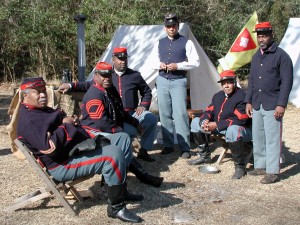
 [Hat-Tip to Marc Ferguson (Nicholson is second from left)]
Mark was kind enough to tip me to an upcoming ceremony planned in Boardman, North Carolina to honor two supposedly black Confederates [History.com Message Board]. Apparently, this is the way the North Carolina Sons of Confederate Veterans Camp 794, “The Columbus County Volunteers” honors black history month. The two men to be honored are Sandy Oliver and Joshua Nichols. No information is given about these men so it is impossible to say anything about their status during the war or the units they supposedly “served” in.
There is a great deal of misinformation included in the announcement, which is circulating on a number of message boards. Let’s start with the keynote speaker. According to the message boards Marvin Nicholson is a retired black educator from South Carolina and has been reenacting for about 13 years. Actually, he is from New Jersey. The uninformed would assume that Mr. Nicholson reenacts black Confederates. I did a quick search which took me to the North Carolina Department of Cultural Resources where Nicholson recently took part in a program on African Americans in the Civil War. What the message boards do not point out is that Nicholson reenacts Union soldiers and focuses mainly on free black North Carolinians who eventually ended up in Union ranks. There is no indication that he has researched or knows anything about the complexity surrounding the presence of African Americans in Confederate ranks. In fact, Nicholson admits that when he retired from the New Jersey public schools he knew nothing about the role of African Americans in the Civil War. We can only hope that he was not a history teacher.
Another thing that makes me suspicious is the way the author of the message board entry cites Nicholson’s suggestions for further reading. The list of books was taken from the NCDCR website, which I referenced above. As you will notice the references have nothing to do with anything related to black Confederates. As to the books referenced, they include John Hope Franklin’s The Free Negro in North Carolina, 1790-1860 (UNC Press) and Howard Zinn’s A People’s History of the United States. Franklin’s book is must reading for those of you interested in the history of African Americans in antebellum North Carolina, and it may help to better understand their situation at the outset of the war, but it does not address directly their eventual involvement in the war itself. I’m not even going to touch the Zinn issue.
If the author of the original message board post is a member of the local SCV chapter than we are in for a real treat as we get closer to the weekend. No doubt, we will see increased attention from the local press as well as other forms of window dressing. It’s been a few months since the Weary Clyburn fiasco so I guess it was about time. I will keep you posted.
Update: A preliminary search by a reader with access to the North Carolina archive reveals that neither man received a pension. I am told that Boardman County is on the border with South Carolina so the two may have served in units in that state.
As a direct descendent of Joshua Caleb Nichols, the thought that he would willingly fight for the confederacy is more offensive to me than it is to anyone of you who would deny the legitimacy of African American service because you consider it a tarnish on your unworthy and lost cause in the ‘war between the states’. Yes, Boardman is in Columbus county NC and borders on Robeson county NC. As someone earlier commented, this area of NC was not sympathetic to the rebel cause. Henry Berry Lowry was the most notorious outlaw Lumbee Indian from Robeson county. The reason? Near the end of the ‘war between the states’, the confederacy rounded up free blacks and Indians from Columbus and Robeson counties and forced them into labor to fortify Fort Fisher against attacks. The horrible mistreatment of them at the hands of the confederacy led to Lowry’s escape and the beginning of his life as an outlaw. Prior to this ‘civil war memorial’ thing, it was common knowledge in the family that, near the end of the civil war, both Joshua Caleb Nichols and his oldest son were “taken”. Joshua Caleb returned home to his family after the end of the war; his son did not and was never located. That is what we KNOW. If I were stolen from my home and family, mistreated while laboring for a confederacy that was fighting for the ‘right’ to keep blacks as slaves, and lost a son who was barely in puberty for the cause of people who hated me, I wouldn’t have filed for a pension either! What honor?! Keep it for those who are of a race who have no shame for having participated in one of the most offensive forms of degradation known to mankind. . .
Tombstone photos
http://cwmonuments.wordpress.com/2011/12/02/joshua-caleb-nichols-and-sandy-oliver/
This is an interesting story and certainly has generated some intellectual discussions. I currently teach at the Army’s staff college and have done so for years. When I first went to work in the history department, I did research on black Confederates and surprisingly found more information than people generally give credit for existing. In 2005, the Army Equal Opportunity Office at Fort Gordon, Georgia invited me to be the keynote speaker on the topic of “Black Confederates”. I have given the lecture numerous times over the last ten years around the United States. Even the most harded, educated skeptics have at least admitted that the evidence is credible that black Confederates served. Mr. Tyrone Williams, a retired law enforcement officer here in Leavenworth, Kansas, is a proud descendent of a Confederate soldier. He is African-American and we ordered a Confederate headstone from the V.A. for his ancestor. We emplaced it on his g-grandfather’s grave in 2006. In my presentations, I always ask people to shed their stereotypes and open their minds. As I close my presentation, I always use photos of numerous post-war reunions showing black Confederate veterans in attendance. I am always curious when the argument is posited that black Confederates “were forced to fight”. I see no pistols to their heads in the reunion photos. Something to think about.
LtCol. Kennedy,
Thanks for taking the time to write. I would love to hear about examples of individual black soldiers that you’ve identified based on wartime evidence, including the muster rolls. Please keep in mind that postwar photographs are not evidence that individual black men served as soldiers. In fact, it is probably the case that most of them were present as slaves or were impressed by the state government. As I’ve noted before many slaves traveled with their owners and were allowed to purchase uniforms. This, of course, did not change their status. The postwar reunion photographs are fascinating documentation, but they tell us much more about race relations and how the war was being remembered as opposed to the status of these men during the war. If you have evidence of black soldiers in the Confederate army than I must assume that you have identified them on muster rolls.
Thanks again for taking the time to comment.
RE: LtCol Kennedy
I somehow managed to miss his comment from a few years ago.
I am more than a bit surprised and dismayed that some supposedly working in the history department at Leavenworth would not only accept this very doubtful bit of folklore & mythology as true, but then proceed to lecture upon it as if were true. That he states, “Even the most harded, educated skeptics have at least admitted that the evidence is credible that black Confederates served,” raises an eyebrow and makes me wonder just what the evidence is that LtCol (Rtd) Kennedy presents that might be so compelling.
Not long after this whole issue regarding “Black Confederates” surfaced in the latter part of the 80s & the early-90s, I took time to investigate it, given that I was engaged in research on a topic covering the years immediately following the War of the Rebellion to the turn of the century related to a southern state, South Carolina. Using what I found in the SC archives and those of several other states, as well as a number of university library systems, on top of the materials from a number of historical societies and museums, I could nothing to substaniate the existence of these “Black Confederates.”
Time and again, the “evidence” presented simply did not hold up to scrutiny. As Mr. Levin and others (there is a link to the University of Illinois below) have pointed out time and again, the pension rolls are full of requests from cooks, body servants, and laborers, not for those who performed military service. I personally checked those in the SC archives and nary a single “Black Confederate” could be found among them.
http://www.las.illinois.edu/news/2013/confederates/
I would be very interested to see exactly what “evidence” Mr. Kennedy has that makes him think that that he can unequivocably support the presence of “Black Confederates,” a feat that has somehow managed to evade the efforts of more than a few professional historians.
True, there is no Boardman County, North Carolina. However, right on the border between Robeson and Columbus Counties, there is a small town called Boardman, population 202. According to the 2000 Census, the town was 54.4% White and 44.6% Black. During the Civil War, both Robeson and Columbus Counties evolved into dangerous “no go” areas for Confederate troops and Home Guard. The Lowry Band, a group anti-Confederate bandits/guerrillas operated nearby. Ironic that in an area known for opposition to the Confederacy during the actual conflict, people want to memorialize so-called “black confederates.”
I also know Marvin Nicholson. Marvin as well as a couple of his artillery team re-enacted as Confederates at the Columns Re-enactment, S. C. 2007. Wherever Marvin sets up his information on Blacks in the Civil War, he always includes information on Black Confederates. I suggest you contact Earl Ijames, currator of the NC Museum of History for more information on blacks that served in the Civil War. He is doing a good work on compiling this information. Earl is also an Afro-American.
I appreciate the references and am well aware of Mr. Ijames’s “research” on black Confederates.
I’d love to see a copy of the biographies for the two men. Apart from the mention of the two being “stationed at Ft. Fisher,” there is little else being conveyed as to the nature of the “service” at Ft. Fisher. Note that the headstones read simply “Confederate soldier” with no unit designation.
Update… http://genebrooks.blogspot.com/2009/02/black-nc-confederate-soldiers-honored.html
Looks like everyone had a good ole time. ha
There is no Boardman Co., NC. There is a Columbus Co., though.
True, there is no Boardman County, North Carolina. However, right on the border between Robeson and Columbus Counties, there is a small town called Boardman, population 202. According to the 2000 Census, the town was 54.4% White and 44.6% Black. During the Civil War, both Robeson and Columbus Counties evolved into dangerous “no go” areas for Confederate troops and Home Guard. The Lowry Band, a group anti-Confederate bandits/guerrillas operated nearby. Ironic that in an area known for opposition to the Confederacy during the actual conflict, people want to memorialize so-called “black confederates.”
Great work Chris. Thanks a bunch.
Joshua Nichols appears in the decennial census for Columbus County North Carolina in 1910, 1900, 1880, and 1870. He is 84, 74, 54, and 57 respectively. In 1910 he answers CA to the question if they served in the Union or Confederate Army or Navy (although the census taker did no favors and almost obliterated the C part of the entry). In every instance he answers that his place of birth was NC. The age in 1870 is problematic – if its right he was 47 in 1860 and would have been 97 in 1910. His ethnicity is always listed as Black – never Mulatto; so less likely he passed.
There are no Nichols, white or black, that I can find in the Columbus County 1860 census.
He is not the person in the 53rd NCST – who was 40 in 1862 and was discharged due to the age limits set by the first Confederate conscription act and was born in VA according to the enrolling information on the compiled service record.
It would be interesting to note if there were more than just the 1910 census backing a claim of service.
I believe we went over some of the laws regarding pensions from NC in previous posts (which see).
Oh no, Craig! May “kharmatic restitution” remain clear of your doorstep!
Maybe I am being insensitive, but every time I hear another “Black Confederate” story I start checking the “Coast to Coast AM” show schedule for a listing.
I know, I’m spreading bad blog carma that will visit me later…
Kevin,
Oh no, not at all. That’s a much more difficult thing to pin down, even among some Confederate veterans who applied for pensions. Just trying to find out the origins for this particular “labeling” in N.C.
I think we are in complete agreement on that point.
Thanks Tom, That’s the same time Virginia started in the practice, early 20s. Just curious, but do you know if this was also done in the rest of the former states of the Confederacy.
Yes, North Carolina granted pensions for body servants and laborers. They started doing so rather late, I don’t have the exact date at my fingertips. I believe it was in the 1920’s.
North Carolina did indeed grant pensions to body servants and laborers, but this should not be mistaken for anything having to do with the loyalty of black Southerners to the Confederacy.
Kevin,
I just spent a little time on Footnote.com and ran the names through the service records available for NC, SC, TN, and general service in the CSA.
In NC records, a Joshua Nichols appears in the 53rd NC, but there is no indication of race (he was and born in Pittyslvania Co., Va.). In S.C., there is another Joshua Nichols in the 21st SC, but no indication of race. There is no record of a Joshua Nichols in the service of TN or in regular Confederate designated regiments.
For Sandy Oliver – no record in NC, SC, or general CSA service, but there is one in the 48th TN. Again, no mention of race in the service record.
I didn’t run a search for the names with first initial alone (“J. Nichols” or “S. Oliver”), but know that this was a standard practice in keeping records in some Confederate regiments (especially those from the deep South, at least in my experience). I just wasn’t willing to start sifting through hundreds of listings (about 104 listings for S. Oliver alone in SC service records).
I did find white males by the same names in some census records, but none (white or free black) listed in Boardman County.
So, with no pension records and no service records, I’m even more curious. Does NC have servant pension records like those found in Va?
Andrew,
Thanks for the additional information.
Richard,
No, I don’t think it is a fine line at all. Although I’ve lived and worked in Virginia for eight years, I am from New Jersey. What is so confusing about that?
Rather a fine line, don’t you think?
Kevin,
I am familiar with Marvin Nicholson, and have heard him give a presentation on so-called black Confederates in the past. That was about 6 or 7 years ago at a symposium here in eastern NC. However, you are correct about his reenacting portrayal; I have only seen him portray US Colored Light Artillery and have never seen him in a Confederate uniform.
When people ask, I always tell them that I’m from Virginia. Of course, I haven’t lived there since 1985.
Mr. Nicholson may be from New Jersey, but he currently resides in or near Myrtle Beach, South Carolina.
“According to the message boards Marvin Nicholson is a retired black educator from South Carolina and has been reenacting for about 13 years. Actually, he is from New Jersey. ”
Now, now Kevin, don’t be so picky. I’ve seen you refer to yourself on your blog several times as a “Virginian.”
But when have I ever stated that I am from Virginia?
The term Free Negro in NC is a loaded term in my opinion. I know of several people who trace there ancestry back to this term and in fact they are Indian.
Nice. According to the message board post, Mr. Nicholson attended SEATON Hall University.
I had to make a decision as to how many mistakes to address. 🙂 Of course, it is Seton Hall University.