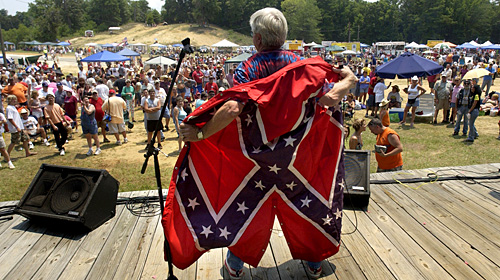
 Can someone please send me directions to the cultural war between the Old South and the New. Sorry, but interviewing the commander of the Sons of Confederate Veterans concerning plans to spread Confederate culture to every municipality in the country and including an image of some dude wearing a Confederate flag jacket as part of the 2006 Redneck Games doesn’t cut it. How many people do you think Charles McMichael speaks for? My guess is that the number doesn’t even appear on the radar screen. Luckily, the reporter included an interview with a reputable historian:
Commemoration of the Confederacy as a noble cause began shortly after the Civil War ended in 1865, said Jonathan Sarris, associate professor of history at North Carolina Wesleyan College. The multicultural angle is an effort to appear more inclusive, he said, but it ignores the facts.
“To say that it is not racist but about multiculturalism is an attempt to adopt a modern mind-set,” Sarris said. “You can call it a victory for the forces of multiculturalism when even the defendants of the Confederacy feel they have to pay some lip service to the idea of tolerance.”
Sarris is absolutely right. [By the way, I highly recommend his recent study, A Separate Civil War: Communities in Conflict in the Mountain South] The fact that the SCV has pushed toward emphasizing the multicultural “appeal” of the Confederacy is a sufficient indicator that even they have left the realm of the past for a mythical one that allows for continued identification and celebration. It wouldn’t be a stretch to suggest that the SCV’s emphasis on their multicultural heritage makes them the hippies of Confederate remembrance. Sadder yet is the reduction of Confederate history and symbolism to the kinds of games pictured above: bobbing for pigs feet, hub cap hurling and the Redneck mud pit belly flop contest. Yeah, I’m sure that’s exactly how their Confederate ancestors hoped to be remembered.
There is no war over how to remember the Confederacy nor is there a cultural war between two Souths. Sure, you can find pockets of partisanship here and there, but do we really believe that a substantial portion of the nation is aware of any of this or feels as if it has a stake in the outcome?
Its true about re-enactors … in Britain there is a very enthusiastic group who re-enact battles of the English Civil War (1641-1651) but those who choose to “serve” in the Royalist forces do not necessarily want to re-instate the Divine Right of Kings. Its a weird pastime … but there are Germans who have never been to the USA whop spend their spare time dressing up as Indians and living in the woods. So equating Confederate re-enacting with a wider “Southern” political mindset is just not true. Of course, there are always the weirdos, like the ones who insist on talking about the “War of Northern Aggression”….
What I really would like these types of discussion to conclude is that the our interpretation of the past does not repress or misalign one region’s history with the viability of a content future.
Exactly, Kevin. Also, at no point did anyone here say anything about historians and their reactions equating to “suppression” of anything. An issue is being created in this exchange where there is none.
Jim,
1. I’m not sure what you mean by a “lack of context and balance.”
2. No one is trying to “suppress or control Confederate commemoration.” As far as I am concerned you should be free to celebrate your “respective heritage” and I’ve never suggested otherwise.
3. The word “complexity” is used often because the study of history is, in fact, complex and incredibly difficult to do well.
I’m seeing a lack of context and balance in these discussions. There are no more Souths than Wests or Norths. If we believe in the Constitution or just inalienable rights, then each person has the right to express his opinion and therefore, his commemoration and celebration however he wishes.
The fact that many fail to view history with that period’s reality results in today’s controversy. Whether defending a Consitutionally-legal, economically-viable, and well-established way of life from the nation’s founding or resisting invasion, combined with the fact that 13 states with others divided rebelled is not for any one person or committee, etc. to suggest policy changes regarding its remembrance. It’s simply too large a part of American history for anyone or even significant groups to pretend to have the ability to “correctly” steer how it is remembered, celebrated, and commemorated.
Every argument I’ve read to suppress or control Confederate commemoration could be applied to the stars and bars at some point. Simply stating that one side won and the other lost, that one group opposes and the other advocates, that some are insulted and others are proud is proof enough to reveal that this country is anything but homogenous. Why we can’t celebrate our respective heritages is beyond me and reflects a severe lack of tolerance.
The word “complexity” gets used a lot here and appears more or less a smokescreen used to detract attention away from the primary goals and movements of the war. Union soldiers came into the South’s “backyards” because of their objectives and resources, where Confederates were best served to fight defensively. It’s as if some believe that if they divide an issue narrowly enough, then they can reach whatever conclusion that they were hoping to make, but that ignores reality. I can assure you that “retiring” Confederate culture will fail.
Oops, this might get confusing. I was writing my last comment before Kevin’s most recent comment which is above mine. Want to make sure that my statement is seen as an extension of my two previous consecutive comments and not in response to Kevin.
I’ll also add that… and this is one of my favorite areas of study… is that enlistments of Confederate soldiers tells us something else. In short (and this is only one area of my studies of enlistments), enlistments that just so happened to fall around the time the Confederate conscription laws were to be enforced tell us something about the level of commitment to an idea of a Southern Confederacy. Some people might argue that, “well, just look at the way any country is at war, a lot of people just don’t want to fight,” but that ignores the circumstances of what was happening in the Civil War. Union soldiers were, “by God!,” in the backyards of these people and, in reflecting on the past, some people today want to talk-up the idea of defense of hearth and home, but that’s not exactly reflected in the actions or lack of actions of quite a number of people in the South.
So, in the modern act of “Confederate remembrance,” I think there is a lot of failure in a reflection of actually understanding the complexities. More importantly, what do people who witness these events take away from them, in terms of influencing their views on history? After all, whether intentional or not, do these events not convey a message that goes beyond someone simply participating to honor his/her Confederate ancestor? Some might even say that they are a form of rhetoric. As a tool of persuasion, some of these events are painting a false picture of the past. It’s not history, but the way that some people are remembering history. In the long run, events of such limited focus (on the Confederacy) are, as I mentioned before, marketed to the general public as instruments of absolutes in defining the South and do more damage to our collective memory than good. There is more a reflection of misunderstanding than understanding in such activities.
Robert,
I agree with everything that you and anonymous have to say on this issue of how to understand and interpret the South. Part of the problem is that the process of commemoration and heritage involves simplifying since an integral component in all of this is one’s emotional identification or response. Pride in x is best achieved by providing a relatively narrow narrative that triggers our empathy and sympathy. Of course, you are evidence that one can take pride in or identify with a past w/o sacrificing the tools of critical history. Unfortunately, folks like you are a rarity in the world of Confederate/Southern heritage. I agree with you that what is problematic is our remembrance of the war and not simply with the history itself. Critical history is process (it’s continually changing) while heritage is static.
Of course, I forgot to clarify that the focus in my comment was on the white Southern population. I think we too easily forget the black Southern population and its representation in our considerations of what defined the Civil War era South.
Robert
“I think part of the problem will all of this is that the South does not become the South until the Confederacy.”
I think the struggle in political circles in years before the Confederacy tell us something quite to the contrary. It’s clear that people identified with region before the war, but that didn’t equate to many of those same people embracing the Confederacy over Union. There were plenty of people who identified themselves as Southerners, but either did not partake in the idea of the Confederacy, who remained and survived as best they could as quiet Unionists in the South during the war, or went to the next highest level of disagreement and participated in activities to undermine the Confederacy and even joined the Union army. This went even deeper into the nuclear family. I can’t tell you how many families I have come across in which fathers disagreed with sons on the idea of supporting the Confederacy. The South was very much a divided entity within itself.
“It is secession which ends up defining, once and for all, what states are in the South and what states aren’t.”
I think a lot of people forget that secession was not carried by referendum throughout the South. Additionally, in the states that did have a referendum there was plenty of coercion in the vote. So I disagree. Furthermore, while many were swept away by the sensationalism of the idea of romance in war, once war was experienced, we realize the levels of conditionality in devotion to the concept of a Confederacy. There’s a lot more to it in the long run.
“So Robert, I’d agree that the history of the South is complex, but also problematic.”
That’s exactly what I didn’t say. I said it’s not the history that is problematic, but the legacy of memory that we have to dig through that is problematic.
“Maybe all of this just boils down to people who think that the definition of the South is solid, unproblematic, and clear versus those who recognize that the “South” is complex and demands exploration, investigation, and explanation.”
… and that is the crux of debate through most of what you see in this blog and mine.
Robert
We have all proven here in this post and comment section that there are indeed many Souths. For the Confederate soldiers for whom the Civil War ended in 1865 and who put the war behind them and moved on, those men and women in modern Confederate remembrance groups who attempt not to honor, but to fight the war all over again, dishonor their memory. Today our President, a man of mixed race, met–as a head of state–the Queen of England. That is something to celebrate and commemorate.
I think part of the problem will all of this is that the South does not become the South until the Confederacy. It is secession which ends up defining, once and for all, what states are in the South and what states aren’t. So Robert, I’d agree that the history of the South is complex, but also problematic. There isn’t a static “South,” so any definition of Southern hinges upon the context in which the term is employed. What does the term “South” pick out? Slaveholding states? Everything south of the Mason-Dixon line? States that joined the Confederacy? I think part of the slipperiness that arises because the Civil War essentially defined the South as states that joined the Confederacy (or at least the Confederacy presented the clearest definition of what precisely constituted the South). Maybe all of this just boils down to people who think that the definiton of the South is solid, unproblematic, and clear versus those who recognize that the “South” is complex and demands exploration, investigation, and explanation.
Greg, I agree, and as historians, when we hear someone literally marketing the idea that the Civil War South is exclusively defined in terms of the Confederacy, then we feel the responsibility to point out that it wasn’t at all the case. People are going to do what they are going to do and it’s not our job to stop them, but I think it is part of professional integrity and dedication to history that strikes a cord within us to counter mis-history with… things other than mis-history. As I stated in a section of my thesis, there are a lot of people who are hung up on absolutes, yes’s and no’s, when in fact, history is defined in terms of maybe’s and perhaps’, and “it’s more complex than that.” (see Cohen and Rosenzweig in Digital History).
In another blog (though it appears my comment has been blocked or deleted… whatever…), I suggested an alternative to the expression “the history of the South is problematic.” Perhaps it should not be described in such a way, but rather, that the history of the South (but my chief focus being on the Civil War South) is more effectively explained as “complex.” It’s not problematic, but it is complex. What is actually problematic is our work as historians in unraveling the mess left in the wake of many (emphasis on “many”) different sets of people oversimplifying and generalizing the war and the people in it. If we don’t do that as historians, then I don’t think we’re living up to our responsibilities as historians.
I don’t think Kevin or any other serious student of the Civil War, its causes and its consequences feel the need to infringe upon people’s chosen methods of commemorating or remembering it. For instance, just because I choose to disagree with overt displays of Confederate sentiment in the modern era does not mean that I am opposed to those displays being allowed. What I object to is these representations, positive or negative, actual or parody, being touted as the end-line of Southern heritage.
Jim, you have been careful in these posts to refer to “Confederate commemoration,” and I admire and appreciate you for that. The fact is there are too few who wish to celebrate Confederate memory who actually attempt to sell it that way. Rather, many attempt to sell it as the only true history of the South. As Kevin, Robert and others have pointed out, this is simply not true. I do not believe that there is a “culture war between the Old South and the New.” I simply believe that if “Southern” history is to be studied properly it must include a great deal more than simply the Confederate perspective. I believe, from what I have read on this blog over the last year, That is Kevin’s perspective as well. He can correct me if I am wrong.
There are many Souths, Jim–and there always were, and always will be. Here is a suggestion for Confederate remembrance: retire the Confederate flag in a respectful manner and display it in a museum to honor the men who died fighting for the Confederacy, as one historian has suggested, then end reenactments.
Confederate remembrance today has almost nothing to do with the lives and deaths of the actual men who are supposedly being honored. It is, instead, a modern ritual devoid of meaning. Add to that the affront to the sensibilities of black men and women that Confederate remembrance offers, and the only way to really honor our nation, and ourselves, is to respect the past as past. It no longer matters why the Civil War was fought. What really matters is that it is still not over. But until we understand the war, once and for all, it won’t be over. Thus, the need for this, and other, blogs. Thanks for your hard work, Kevin. (I am sure you know this, but there were not four million white southern slaveholders. There were, however, four million slaves who were freed as a result of the nation’s bloodiest war. I’ll leave it there, because anything further will cause another futile debate. You are caught in the middle, Kevin. Now you are a true Virginian. That is where Virginians have always been in this godawful history–somewhere in the middle–nowhere–and in hell, at times. Just ask any black man or woman over sixty, or any white man or woman who tried to help. )
I didn’t mean for you to take that personally, nor did I mean to suggest that you don’t do your homework. Unfortunately, I don’t see any suggestions. I think the ultimate no-beating-around-the-bush question I have for you is, what exactly is your end-goal/interest in how Confederate commemoration evolves and is acknowledged?
I guess I should surmise from your comment that you feel ALL historical commemoration is “divisive”. But I notice that we still positively commemorate Jamestown, Plymouth, Columbus Day, and Thanksgiving Day without any real reference to the decimation of the native peoples. Apparently, these heritages sell just fine.
BTW, I’m not sure what time period you were referring to regarding population, but the South had over 7 million whites and 4 million blacks as of 1860. The North had over 10 million whites and less than 0.2 million blacks at the same time.
“Individuals are free to remember the past as they choose ” – Yes and maybe this be the final answer.
Jim,
I didn’t take your comment personally at all. In fact, I appreciate you taking the time to share your thoughts. I wanted to be as direct as possible in my response. I’m not sure what you are looking for n asking me for suggestions. You said: “I think the ultimate no-beating-around-the-bush question I have for you is, what exactly is your end-goal/interest in how Confederate commemoration evolves and is acknowledged?” That’s a great question and one that I will think about and respond in a future post.
I think all of the events that you’ve mentioned have involved some level of controversy. I will go w/ your population numbers, but my my point still stands re: your suggestion as to how we should remember and commemorate the Confederacy.
Jim,
Interesting comment.
1. I’m not sure what you mean by the first sentence.
2. I do not interpret what I am doing as dividing and conquering Confederate commemoration. Individuals are free to remember the past as they choose to and I am free to comment on it. Commemoration of the past is necessarily divisive because it almost always involves making choices which leave out competing memories that fail to fit in in a way that dovetails with a preferred narrative. And you are absolutely right that there may indeed be as many Souths as there are individuals. Personally, I am not interested in commemorating a Confederate past, but I am very interested in better understanding how it evolves and continues to be acknowledged. There is nothing intellectually easy about that. In fact, I find that it involves a great deal of time spent alone reading and pouring through archival material for hours on end.
3. That you interpret my blogging as an attempt at marginalizing Confederate heritage tells me much more about you. Your final point seems to me to be a strawman argument since as far as I am aware no one is suggesting an abrupt change in anything. And your suggestion that we ought to perceive the war as a heroic resistance to a government “that no longer served the interests of its people” gets us right back to the beginning since I assume you mean to refer to 4 million white Southerners and not the 4 million people that they owned. Good luck selling that little heritage gem to this nation’s black population.
The same way the North divided the South along the Mississippi in war, I’m sure you don’t want to divide and conquer any Confederate commemoration. Take the comments above that any commemoration leads to disagreement about how to do so because of the “many” Souths. How many Souths are there? Surely one would get as many answers as there are people. But how that differs from any other historical commemoration one can only wonder.
So, is the answer to criticize Confederate commemoration? Or is it to join in and contribute to the the best of your abilities? It would great to hear of how proper Confederate commemoration should take place because I can’t think of anything intellectually easier and less productive than to criticize something without offering any solutions. Please provide any suggestions on the direction Confederate commemoration should take.
I hope you see where I’m going: excuses of complexity, diverse opinions, “many Souths”, etc. are no reason to marginalize Confederate heritage. I personally believe that changing legal, political, social, and economic conditions abruptly can lead to instability, which is what I perceive happened in the CW. Therefore, one takeaway from the war would be the heroic resistance offered to a government that no longer served the interests of its people. Another takeaway is the cost of a divided nation and the heroic efforts to preserve that nation. Why both of these views cannot be celebrated is beyond me.
FYI, this particular article reached further than the LA Times. It also appeared in the Chicago Tribune sans the same photos used in the LAT.
http://www.chicagotribune.com/news/nationworld/chi-race-confederacy_bdmar22,0,7235836.story?track=rss
Born a Virginian and a Southern in ’79, I’ve multiple Confederate veterans as my ancestors. While I already have mixed emotions on my heritage and how to express it, I can’t help but feel irritation and shame when I see the SCV presenting itself as representatives and guardians of that heritage. When I see it represented in such a manner that ignores such basic facts as slavery as a root cause, it makes me all the more hesitant to speak of what they so proudly trumpet.
One last question, concerning the Sarris book… My ancestors who fought in the war were all from mountainous Southwestern Virginia. Is his work on the Georgian mountain south applicable to Virginia’s stretch of the Appalachian?
… and I’m quite honored that you see me that way, Kevin…
Re: the SCV playing up the Confederacy’s multicultural appeal — see minutes 4:26-12:30 of last year’s “BackStory” episode on veterans. It’s an interview that Ed Ayers did with an SCV spokesman, in which the spokesman attempts to make that point. (Full disclosure: I’m the producer of “BackStory.”)
http://www.backstoryradio.org/2008/11/battles-on-the-homefront-a-history-of-veterans/
Tony,
Thanks for the link.
Sherree,
You are absolutely right in pointing out that there are fault lines over how to remember/commemorate the history and heritage of the South. Any act of commemoration necessarily leads to dissonance given the problem of selection and bias that is inherent in the process. Part of the problem is that a narrow Lost Cause view of the Confederacy and the South has held sway for so long that any challenge to it is dismissed as progressive, liberal, northerner, etc.
I also agree with your comment re: the SCV. I know a number of members who are well read and understand the complexity of the history, but over the past few years the organization has been dominated by reactionaries who have tended to go for big bangs in the public sphere rather than more sophisticated forms of remembrance that acknowledge the reality of “many Souths.” Robert Moore is my idea of a proud Southerner. He is a serious historian in his own right and he does not shy away from wanting to acknowledge his forebears.
Kevin,
You did make the point that the article lacked depth and analysis. That is why I made reference to your previous comment. Also, I agree with you that the SCV preferred view of the Civil War reduces much to caricature. I do believe that there are some individual members in the SCV who have a more nuanced understanding of the war. They don’t seem to have a voice in the organization, however, so their voices are seldom heard.
There is indeed a cultural war for memory within the South that involves southerner vs southerner, so the reporter, if she had dug a little deeper, would have tapped into a truly riveting story, and I am not just speaking of the many different competing perspectives of white and black southerners; but further, of the competing perspectives of black southerners with other black southerners, and of white southerners with other white southerners, which reflects the past very succinctly, since the South was never monolithic in its response to the Civil War to begin with, as you and others have discussed at length. This is the story that needs to be told, and once it is told, the present will truly begin to reflect the past and maybe even move beyond it at last, since the lost cause view of the war enslaved our entire nation by tying us to a past that never existed in the first place, and all that that entailed for so many men and women.
Sherree,
Wonderful comment! I agree with you completely that the article (like so many others) failed to do justice to the bigger questions surrounding the connection between history and heritage. It’s funny, but I thought I had made that point pretty clearly at the beginning. Unfortunately, that is the state of our mainstream media; they are much more interested in entertainment than the transference of information.
So, is there a culture war in the South? Well, if our first move is to ask the SCV than the answer is clearly yes, but given their membership it seems reasonable to question their authority to speak on such a topic. Williams seems to think that McMichael doesn’t claim to speak for the South, but that is ludicrous given the fact that I’ve never heard the SCV offer anything more than an overly simplistic-even childish view of what is considered to be worth remembering. It’s a narrow view that gives priority to a white interpretation and relegates everything else as ancillary or attempts to appropriate it in a way that reinforces their preferred view.
The SCV’s view of the history of the South ultimately isn’t much better than the image presented in the Redneck Games. They both offer, as you say, “caricatures” that are “devastatingly dangerous.”
In the final analysis, I think this article represents what you said it represents before, Kevin: sloppy reporting, and/or–I will add–sloppy editing, it appears. If the “Redneck Games” event is a spoof, as Richard indicates in his post, and the event is not endorsed by the SCV, the picture doesn’t belong in the article. (I watched a video of the Canadian “redneck games”. Truly bizarre, and having nothing to do with traditional rural culture–at least not the rural culture within which I had the privilege to come of age. We actually did bob for apples, not pig’s feet, when I was a child, and this always happened in the fall at apple harvest. We also danced the Virginia Reel and ran through cornfields, when we weren’t instructed to either pick the corn or shuck it. There was a certain magic in the air at the time of apple harvest that I cannot evoke here, and to see this magic reduced to what seems to be a well entrenched and accepted denigration of rural culture in at least two nations is alternately infuriating and comical. It is like telling a black man or woman that who he or she is has been fully depicted by black face or the Amos and Andy show, or Indigenous men and women that cowboy movies correctly convey their identity, which, of course, has been done in the past–the comical part coming from conversations of members within these respective communities who know how foolish these caricatures are; the fury from knowing how devastatingly dangerous )
The continued use, by members of the media, of extremes of Southern culture to represent the culture as a whole–both black and white southern culture–would be a strawman argument of the highest degree, if those media members knew any better. That is the worst part of it. They believe their own fantasies, since those fantasies are the product of the larger narrative not of history, but of popular culture–a narrative that reduces Southerners of all races and religions to two dimensional stick figures in a really bad sitcom posing as a morality play. All of this is not to say that I am endorsing the SCV, because I am not. My perceptions of the SCV were formed during the civil rights era. Those are difficult memories to overcome. Yet, some people are doing it. A local African American legislator became an honorary member of the SCV in a public ceremony. On the other extreme, a local African American columnist writing about a sit in in the 1960s that turned violent, said that a young white man who was involved in the sit in had no place being involved and that he was basically cowardly and only got out of the fight that erupted because of the black men and women who saved him. Dr. King never denigrated men and women of other races who had the courage to overcome “the appalling silence” of the good people. The columnist, who is a fairly young woman and who was not involved in sit ins, to my knowledge, did, however. Then, of course, there are the racists from both the north and the south who exemplify “southern hatred and northern prejudice”. These are but a few examples of the complexity of this issue in my own backyard, Kevin. I see none of this in the article in question.
Robert,
That’s a very interesting point re: the disconnect between how certain days are currently acknowledged in contrast to their past meanings. If you want confirmation of just how few Americans recognize the importance of Lee in our history just consider his bicentennial, which passed w/o much of any notice.
I admire your willingness to try to explain yourself on Williams’s blog, but don’t you think it’s futile? I still can’t get over his post. Great stuff. 🙂
Greg, I agree with you on Brooks’ generalization. I’m also not surprised that most folks in Texas don’t know that it is REL’s birthday, nor do most care or think about it until something about it shows up in the media. It’s the resurgence of activity around those days that, in many cases, is disconnected from the manner in which those same days were even recognized in the past.
Kevin,
About your update: The fact that the reporter would neither confirm nor deny does not indicate a lack of knowledge, but rather protecting a source, something about which Mr. Williams does not comment. As a former reporter myself, you never reveal information from a source you don’t use in a story, not and expect to ever use that source again. While I find the reporter’s use of ellipsis marks in Brooks’ comment interesting, I can only do that — find it interesting. I would expect the reporter to be insulted if I called asking what was left out and my ear to turn red from the cussing I would get!
Greg,
The reporter never makes an explicit connection between McMichael and the Redneck Games so the response to Williams’s question is not surprising. My guess is that someone at the newspaper included the image for effect and may not even have read the story to begin with. I don’t even know if the story ran in their printed edition. In the end, however, my supposed connection between the two is not really Williams’s concern.
You are correct. It was set to coincide with Robert E. Lee’s birthday, which was long before Martin Luther King’s, and the holiday was set long before official remembrances for MLK began. I should have been more clear in the context in which I placed that comment, For the most part, few people in Texas even realize the same date is either REL’s birthday or Confederate Memorial Day, which, in my opinion, makes Rep. Brooks’ comment even more absurd, at least as it relates to Texas.
Greg,
Wasn’t that specific day set aside in Texas for Confederate Memorial Day a long time ago? I mean, I know, in Virginia for example, the day was set aside and pretty much faded away until the new Confederate remembrance movement got under way. Is it the same in Texas or has it been consistently recognized and celebrated ever since established? Isn’t the coinciding with MLK day just a “happening” that some people think happened in reverse? (MLK preceded Confederate Memorial Day… which I don’t think was the case).
Robert
Does it make me angry that people like this attempt, rather poorly, to represent Southern heritage? Yes, but as you mention, Kevin, that this story passed as quality journalism is even more pitiful.
Do I think it is appropriate to have a Confederate remembrance day on the same day we remember an African-American civil rights leader, as we do here in Texas? No, but neither do I agree with Georgia State Representative Tyrone Brooks when he says:
“These Southern states really still have not come back into the Union. That is why it’s been so difficult over the years to get the states to recognize that flying the Confederate emblem on the flag, holding reenactments and pushing these calendar events as a matter of law is a reflection . . . of their Confederate mentality.”
Some representations of Southern heritage are a “reflection…of their Confederate mentaility,” e.g. “big ass” Confederate flags on the side of a major highway. Reenactors may be a little wierd, but that would apply to all of them, Confederate and Union. To say, “These Southern states really still have not come back into the Union,” begs the question of why he believes that way. Most of whites in Texas, even those who believe in celebrating “all” things Southern, consider ourselves Americans, not Confederates. In my opinion, that could be said of most reasonable white Southerners in all former Confederate states.
Isn’t that interesting? What did the reporter leave out of Brooks’ statement with the use of ellipsis marks? (…)
I’m with Sherree. The people in this story have no business posing as representatives of Southern culture. They’re a parody of it.
–ML
Brooks,
Are you sure that the SCV is not already selling such an item?
With all of the railing against liberals and progressives for attacking Southern heritage I’ve seen many more images of these very same people involved in some act of defamation – from that big ass Confederate flag flying over a Florida highway to the individual in the post image wrapped in his Confederate jacket.
I have to second Kevin’s recommendation of Jonathan Sarris’s book. Sarris’s research would seem to support the assertion I’ve seen Kevin make here on the blog that there were multiple Souths as opposed to the single monolithic view of the South often espoused by groups like the SCV. I actually had the pleasure of taking two of Dr. Sarris’s classes in college, when he was still teaching at Appalachian State, and he was an excellent teacher.
Next they will be selling CSA Snuggie blankets. Then you can warm yourself next to your very own Sherman fireplace (please use with care).
Clearly this is the best way to treat the CSA battle flag with the proper respect. All hail Heritage ($), not Hate!
You said it, Kevin. I think I’ll take my copy of today’s LA Times and wrap my gefilte fish in it.
Have a great day! Sherree
“I think it’s clear that the SCV is easily the biggest threat to Southern heritage.”
I think you are spot-on in saying this, Kevin.
Robert,
I think it’s clear that the SCV is easily the biggest threat to Southern heritage. Their overly simplistic framing of what constitutes the Southern past and why it is relevant has almost nothing to do with the broader narrative of this country. The Sarris book is absolutely worth your time. It’s actually a quick read.
Sherree,
You are right in pointing out that the reporting (if that’s what we are to call it) is part of the problem here. It’s an easy story to report because the public discourse allows for a sloppy framing of the issues. There is no attempt to look below the surface. And then people wonder why the major newspapers are going under.
Having eaten a couple of pig’s feet and completed my daily mud pit belly flop, I am ready for the day! YEEHAW boss, hand me my Confederate flag mini skirt and fishnet stockings, will ye? And don’t forgit my Tammy Faye fake eyelashes! Looks like the South is gonna rise again for sure, y’all.
We see what we want to see, Kevin–hear what we want to hear–select information that fits what we already think, and move through the world in separate universes. The best we can hope for, at times, is to live in a state of peaceful co-existence, as an African American co-worker once said to me in the 1980s, despairing that true equality of the races would ever be reached.
Actually, I ate gefilte fish this morning, since gefilte fish–especially the way my husband cooks it–is one of my favorite breakfast foods. One day I had a man ask me “how I could stand to eat that stuff that Jewish men and women ate?” This man, who was an acquaintance and not a friend, but who should have known better since he is not white and he is not Gentile, taught me something by that comment and by the attitude that was behind it: the suffering of men and women of one race or religion does not necessarily translate itself into an understanding of the suffering of men and women of another race or religion. The belly flopping pig’s feet eaters featured here are not suffering. The men and women who are, and have been, categorically lumped with them culturally for quite some time now are, however, as are the African American men and women who are inextricably linked to them historically. This is not going to change, though, I have realized–not yet anyway. Some day it will, however, and the equation of this type of nonsense with white southerners in general will be as ridiculous as the equation of modern day Italians with the excesses of the Romans. (I know you are not doing this. I am speaking of the article you referenced. You are posting these thoughts within the context of many posts in which you truly attempt to understand. The LA Times reporter takes a quick swipe, has some fun, and then is off to another story. That is the difference, Kevin.)
By the way, Kevin… thanks for the heads-up on that book by Sarris. Considering my interests in Southern Unionism, I certainly need to take a look at it.
Thanks for the Monday morning treat, Kevin…. uggghhhhh…
Of course, it’s obvious that McMichael is delusional if he thinks he is speaking for all Southerners, most especially those Southerners who opt not to join or participate in the SCV for obvious reasons, yet still have respect for their ancestors who served in gray. It’s also clear that McMichael and those who “herd” (yes, I’m using a metaphor that someone else frequently uses) under his brand of “Confederate remembrance” pick and choose from the greater heritage that is the Civil War South and repackage it as the total truth for ingestion by those who think the South and Southern heritage is about silly Confederate flag overcoats, hub hurling, and “the Redneck mud pit belly flop.” Confederate veterans would be just tickled pink to know that they are remembered so respectfully (if the sarcasm isn’t apparent in my comment, please interject it here, now). Just more evidence that the SCV has lost its way and continues to spiral downward.