 I get a kick out of the editorials and short essays by Calvin Johnson, which you can find at such places as Lew Rockwell and the Conservative Free Press. Given the last few posts on the mythology of black Confederates I thought it might be nice to share another little story. Yes, I am beating a dead horse, but if this blog can help to correct this skewed view of the past than my time on this site will be worthwhile. In this essay, Johnson examines the history of the monument to Confederate soldiers, which is located on the grounds of Arlington National Cemetery. The monument was organized by the United Daughters of the Confederacy to mark the graves of 267 Confederate soldiers. Designed by Moses Ezekiel, it was unveiled in 1914 and included a dedication speech by President Woodrow Wilson. Here is what Johnson has to say about the monument itself:
Around the start of the 20th century this country also honored the men who fought for the Confederacy. This site of men who fought for “Dixie” is located in section 16. There is an inscription on the 32.5 foot high Confederate monument at Arlington National Cemetery that reads, “An Obedience To Duty As They Understood it; These Men Suffered All; Sacrificed All and Died”! Some claim this Confederate Monument at Arlington may have been the first to honor Black Confederates. Carved on this monument is the depiction of a Black Confederate who is marching in step with the White soldiers. Also shown is a White Confederate who gives his child to a Black woman for safe keeping.[my emphasis]
What exactly is Johnson referring to? The photographs below are close-ups of the freezes included around the perimeter of the monument.
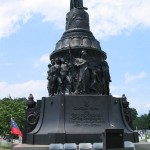
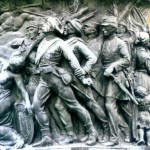
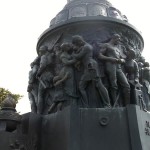
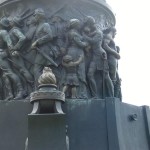
You can see what appears to be a black man marching in rank with Confederate soldiers as a well as a female slave who is about to take charge of what must be her master’s children. This is a wonderful example of why the study of memory is so important to our understanding of the Civil War. To understand this statue and the choices of the sculptor we must understand the historical context in which it was dedicated. Monuments and other public spaces dedicated to historic events are as much about the time in which they were build as they are about the event in question. The year, 1914, places us right at the height of Jim Crow. The images helped to justify the emphasis within Lost Cause narratives of loyal slaves and a war that was supposedly fought simply for states rights. Wilson’s presence at the dedication is also important given his order at just this time to segregate federal office buildings along racial lines. In other words, this is not simply a monument to commemorate the lives of Confederate soldiers, but part of an attempt to shape a certain version of the past that worked to minimize the theme of emancipation and distance the Confederate experiment from the preservation of slavery altogether. The enforcement of white supremacy by legal means helped to ensure that African Americans would be unable to shape their own emancipationist legacy of the Civil War, which in turn helped to perpetuate the political monopoly that whites enjoyed through the 1960s.
Unfortunately, Calvin Johnson doesn’t really understand what he is looking at.
The original pamphlet from 1914, giving the history of the monument’s development and construction, explicitly identifies the African American man as a body servant:
“Marse Chan” refers to a popular short story about a slave who follows his master to war. Your interpretation and the comments here all peg it correctly, but I thought the original (and official) description would be useful. Sorry if it’s been covered elsewhere; I’m still digging through your old posts.
As Bruce Levine points out “In Search of a Usable Past: Neo-Confederates and Black Confederates,” Arlington National Cemetery's website labels the figures in the monument's frieze as “a black slave following his young master.” http://www.arlingtoncemetery.org/visitor_inform…
Citation:
Bruce Levine, “In Search of a Usable Past: Neo-Confederates and Black Confederates,” in Slavery and Public History: The Tough Stuff of American Memory, ed. James O. Horton and Lois E. Horton (Chapel Hill: UNC Press, 2006), 187.
Excellent essay and dynamite book. I actually wrote a few posts about the Levine essay which you can easily find.
In previous posts regarding artwork depicting Robert E. Lee alone on his estate (which was comprised of 1,100 acres), Kevin laments the absence of slaves. “After all he lived with these people”, Kevin lashed out. Yet when blacks are included in a monument to the Confederacy (gasp), Kevin attacks their presence as if some were both not really there or never went to war along with the Confederacy, even though blacks represented 40%+ of the South’s population. It’s time to weigh the levity of Kevin’s opinions against the gravity of empirical evidence and law of probability and reach our own likely conclusions.
Jim,
“Lashed out”? Now that’s pretty funny.
“Yet when blacks are included in a monument to the Confederacy (gasp), Kevin attacks their presence as if some were both not really there or never went to war along with the Confederacy, even though blacks represented 40%+ of the South’s population. It’s time to weigh the levity of Kevin’s opinions against the gravity of empirical evidence and law of probability and reach our own likely conclusions.” Well…whatever makes you feel better. What empirical evidence? By all means, feel free to conclude anything you want, but please don’t call it serious history.
Thanks Karen and Kevin for the suggestions. Karen, I would like to see the monument both for its artistic beauty, and for its importance in the history of how the Civil War has been remembered in our society, and will do so on one of my trips North! Thanks again. Sherree
Sherree,
I also highly recommend Karen’s book on the UDC which is titled Dixie’s Daughters (University Press of Florida, 2003). Another book that is worth reading is Caroline Janney’s, Burying the Dead but Not the Past: Ladies’ Memorial Associations and the Lost Cause (University of North Carolina Press, 2008).
Hi, Sherree. Book essays are usually not online. You’ll have to check out the book and then look up the essay within it. And, if you ever get a chance to visit it, the monument is really incredible. Karen
Thanks, Kevin. I will pursue the books you mention. Also, is Karen Cox’s essay online? I found references to the book, but not to Karen’s essay. I would like to read the essay. Finally, this is a question of logistics that local librarians are unable to answer. Is there some sort of interlibrary loan system in place between academic libraries and public libraries? It is difficult to get quality information. Thanks again, Kevin.
Sherree,
I highly recommend Bruce Levine’s Confederate Emancipation (Oxford University Press, 2007) as well as Joseph Glatthaar’s Robert E. Lee’s Army (Free Press, 2008). You can peruse the bibliography for additional references. The relevant literature on this topic includes slavery and race relation studies. Relevant historians include Bertram Wyatt Brown, Eugene Genovese, and Leon Litwack.
Karen Cox,
It is indeed an incredibly beautiful monument. Thanks for adding that detail about Wilson as well as the reference for your article.
Brooks,
Well, given the fact of interracial sexual contact in the antebellum South you wouldn’t be too far off at all.
Brooks, you should remember to use a smiley when making a joke 😉
How do you know for sure who is the mother of that child?
One could read the monument as celebrating multiracial relationships.
I have an essay on this monument in Simpson and Mills eds., Monuments to the Lost Cause: Women, Art, and the Landscape of Memory (the cover photo on the book’s jacket is of the grouping that includes that soldier.) My sense is that this black “soldier” is really a body servant. Moses Ezekiel never (as far as I’ve been able to uncover) made mention of this figure and its meaning. The black female is obviously a mammy figure. What is interesting about the unveiling is that although Woodrow Wilson was there, he never gave his speech because a thunderstorm erupted and sent everyone scurrying for shelter or to their cars. The full text of the speech was carried in the Washington Post. It’s a magnificent statue and work of art, albeit one steeped in Lost Cause mythology.
Thanks, Kevin. This post is excellent. Also, in another comment, you answered a question that I had. Ervin Jordan’s book received mixed reviews, you said, but is a serious study of the subject. Any other suggestions for your readers? Thanks.