Kevin:
The truth is, what I’ve learned through teaching about the Civil War over the last two years leads me to believe that the Civil War section of the course will prove to be a cross-between “Civil War ‘Myth Busters'” with my white students and _Don’t Know Much About the Civil War_ with minority and foreign students. My apologies to the Discovery Channel and Kenneth C. Davis for these comparisons.
I have been pleasantly surprised that my students, all of them, have been way more open to questioning established Civil War historical interpretation than adults I’ve encountered. While some may not shift their personal views, the debate has always remained lively and respectful. Usually, the “agree-to-disagree” approach is taken, but some have changed their views. Others have followed my lead by going and acquiring their own resources for further study or borrowing mine.
Kevin:
This does present a unique perspective to take into account as I begin to teach my American Government/Civil War Studies elective next year. While we are not a greatly diverse school, I have not, until now, thought about how I would approach the study of both topics with a racially and ethnically diverse group.
Mike:
You are right. The TEKS do limit how information can be presented in the standard US history class in Texas. That is one of the reasons I suggested the more in-depth elective I mentioned above. In my opinion, the TEKS do not require enough for students to have a good working knowledge of these topics, much less an understanding of the complexity of issues related to them.
Kevin LevinMay 17, 2009 @ 13:03
Greg,
You hit the nail on the head, though I do wonder whether the racial/ethnic profile adds much more to the generational divide. In other words, for most teenagers the Civil War is perceived as distant past. Our job than as teachers is to present the history in a way that engages students in the big issues such as slavery/race along with the brutal facts of war, and their long-term consequences. I find it just as much a challenge to teach my white students who know of ancestors who fought in the war as I do with our foreign students. Actually, it’s quite often the foreign students who are more engaged in the study of American history.
Kevin LevinMay 17, 2009 @ 12:32
tf,
Good point.
tf smithMay 17, 2009 @ 8:26
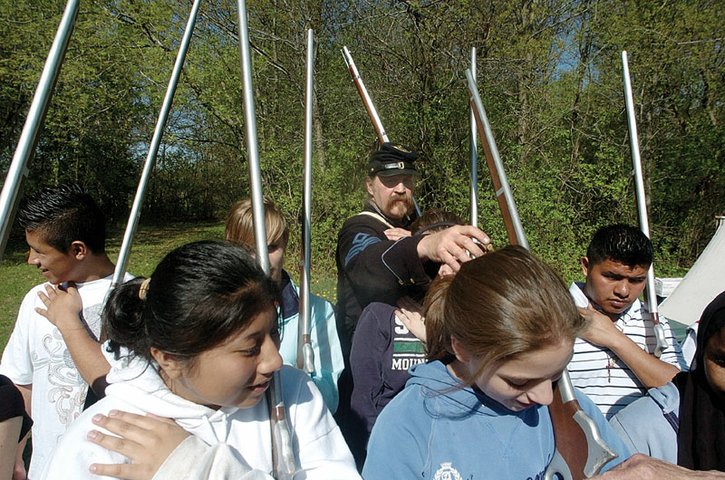
Interestingly enough, looks like six girls and two boys, which would be fairly ahistorical in its own right!
But in terms of (a loaded word) “race”, it looks like four with (mostly) “European” ancestry, three with mixed “European/native American” ancestry, and one (based on the scarf) of mixed “European/African” or (southwest) “Asian” ancestry – which might not have been all that far off from the historical ratios on the Minnesota frontier in the 1860s, honestly…
matt mckeonMay 12, 2009 @ 15:05
Those kids are Americans, regardless of where their families came from. The Civil War is part of the story of their country, and an essential part in understanding our history.
I teach in a school with students from all over the world (In fact in my department of less than an dozen, there are three foreign born teachers). It’s an opportunity, not a problem.
Although my aide, from Albania, did ask me why Americans are lazy and weak. I told her it was because of xbox.
MikeMay 12, 2009 @ 10:48
I never thought about it Kevin when I taught’ I just presented the facts as laid out under the TEKS ( Texas Essential Knowledge and Skills ) which mandates the basic information we have to teach down here.
Kevin LevinMay 11, 2009 @ 12:29
That’s right and it raises interesting questions about the place of the Civil War in our culture and how we go about introducing it to a student body that reflects a broader ethnic swath.
MikeMay 11, 2009 @ 11:13
Defiantly not the make up of either army in the war.
Kevin LevinMay 11, 2009 @ 8:10
Sure, but I am much more interested in the ethnic profile of this particular class.
MikeMay 11, 2009 @ 6:36
That is a great Idea to get them out of the classroom and to feel what it was like to be a soldier in small section of the daily life of a Soldier.
Kevin:
The truth is, what I’ve learned through teaching about the Civil War over the last two years leads me to believe that the Civil War section of the course will prove to be a cross-between “Civil War ‘Myth Busters'” with my white students and _Don’t Know Much About the Civil War_ with minority and foreign students. My apologies to the Discovery Channel and Kenneth C. Davis for these comparisons.
I have been pleasantly surprised that my students, all of them, have been way more open to questioning established Civil War historical interpretation than adults I’ve encountered. While some may not shift their personal views, the debate has always remained lively and respectful. Usually, the “agree-to-disagree” approach is taken, but some have changed their views. Others have followed my lead by going and acquiring their own resources for further study or borrowing mine.
Kevin:
This does present a unique perspective to take into account as I begin to teach my American Government/Civil War Studies elective next year. While we are not a greatly diverse school, I have not, until now, thought about how I would approach the study of both topics with a racially and ethnically diverse group.
Mike:
You are right. The TEKS do limit how information can be presented in the standard US history class in Texas. That is one of the reasons I suggested the more in-depth elective I mentioned above. In my opinion, the TEKS do not require enough for students to have a good working knowledge of these topics, much less an understanding of the complexity of issues related to them.
Greg,
You hit the nail on the head, though I do wonder whether the racial/ethnic profile adds much more to the generational divide. In other words, for most teenagers the Civil War is perceived as distant past. Our job than as teachers is to present the history in a way that engages students in the big issues such as slavery/race along with the brutal facts of war, and their long-term consequences. I find it just as much a challenge to teach my white students who know of ancestors who fought in the war as I do with our foreign students. Actually, it’s quite often the foreign students who are more engaged in the study of American history.
tf,
Good point.
Interestingly enough, looks like six girls and two boys, which would be fairly ahistorical in its own right!
But in terms of (a loaded word) “race”, it looks like four with (mostly) “European” ancestry, three with mixed “European/native American” ancestry, and one (based on the scarf) of mixed “European/African” or (southwest) “Asian” ancestry – which might not have been all that far off from the historical ratios on the Minnesota frontier in the 1860s, honestly…
Those kids are Americans, regardless of where their families came from. The Civil War is part of the story of their country, and an essential part in understanding our history.
I teach in a school with students from all over the world (In fact in my department of less than an dozen, there are three foreign born teachers). It’s an opportunity, not a problem.
Although my aide, from Albania, did ask me why Americans are lazy and weak. I told her it was because of xbox.
I never thought about it Kevin when I taught’ I just presented the facts as laid out under the TEKS ( Texas Essential Knowledge and Skills ) which mandates the basic information we have to teach down here.
That’s right and it raises interesting questions about the place of the Civil War in our culture and how we go about introducing it to a student body that reflects a broader ethnic swath.
Defiantly not the make up of either army in the war.
Sure, but I am much more interested in the ethnic profile of this particular class.
That is a great Idea to get them out of the classroom and to feel what it was like to be a soldier in small section of the daily life of a Soldier.