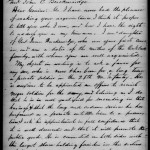
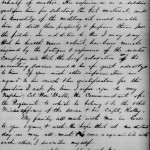
Thanks once again to Vicki Betts for passing along documents related to the controversial issue of black Confederates. This latest gem is a letter from John C. Breckinridge’s cousin (Matilda Breckinridge Bowyer, of Fincastle, VA) recommending her son to recruit black soldiers, dated March 26, 1865. What is so striking, however, is how unremarkable it is. The document fits perfectly within the narrative accepted by professional Civil War historians and serious students of the war. Not until March 1865 did the Confederate government authorize the enlistment of a limited number of slaves into the Confederate army. There is nothing unusual about a mother with close ties to high political office, who attempts to advance her sons career following the passage of new legislation.
It is also worth commenting on what this letter fails to acknowledge. At no point does Matilda Breckenridge acknowledge that slaves were already serving in Confederate units. Nor does she suggest that her son had any experience with or prior understanding of the recruitment of slaves as soldiers. In fact, I have never seen a letter written by a Confederate civilian, soldier or politician that points to the presence of a significant number of slaves serving as soldier in the Confederate army.
It appears most who comment here have public educations or at best educated through historical commentaries. In most of the States of the Confederacy and especially in Virginia, Texas and Louisiana many slaves owners enlisted their own slaves to serve with them or their sons in many cases. From the early part of the war those slaves who had been enlisted were promised complete and full citizenship. A very large part of the Confederate Medical Corp was comprised of Negros. Not only so if you check the records of the retirements received several Blacks received paid benefits for serving the south in the medical corp.
The greatest conflict was not that of Negros serving, but that of serving as combatants and having enlisted alone…..i.e. without the authorization of their owner and or a writ of citizenship. Units such as the Mobile Guard and even many magazine post were manned and managed largely by Negros. The greatest problem with the enlistment of Negros was the expense and capacity educate them in order for them to serve in the armed forces of the South. The other pending obstacle was to place them in units and capacities that would not stimulate weaknesses or oppositions with in the Confederate Military structure. When commenting or studying on the War of Northern Aggression, try utilizing physical documents, military archives, personal testimonies, and newspapers……like those of New York and Mass. that show slaves were being sold in both harbors until mid 1863. Yet some still want to believe the fiction that the War was fought over slavery!
John Q. Adams famously predicted that a serious war would “interfere” with slavery. McCurry is describing Confederate officers, doing the interfering. Not exactly bringing the Julibee, but certainly disrupting slavery to achieve what West Point trained them for: victory.
Not sure what you’re trying to get at with this quote. The impressment of slave laborers is vastly different from the voluntary recruitment of gun-touting black Confederate soldiers. There is nothing particularly unique or remarkable about the former, and this quote certainly provides no proof of the latter. Note the newspaper expressly states that the impressed blacks were “laborers.”
Not surprising the planters of Mississippi would complain about it, either. From their perspective, the Confederate government was temporarily stealing their ‘property’ and cutting into their potential profits.
The quote actually reflects a very important point that Stephanie McCurry makes in _Confederate Reckoning_ and that is that the slaveholders themselves resisted almost all attempts on the part of the Confederate government to employ slave labor for military purposes. You are right that this has nothing at all to do with the recruitment of slaves as soldiers.
From their perspective economically, it’s certainly understandable that they would resist such actions. Thanks for the additional info.
Adding Confederate Reckoning to my Wish List now… 🙂
Interestingly, there concern seemed to be more in terms of maintaining absolute power. McCurry includes a number of insightful sources that clearly show that slaveholders believed that the central government was overstepping its bounds and becoming more oppressive throughout the war.
The Era, New Orleans, Louisiana – Apr 8, 1863
“The policy adopted by the rebel Government in impressing negro laborers into its service, is loudly complained of by the planters of Mississippi.”
Exactly – when the Confederates start recruiting black soldiers there are all kinds of ads in the Richmond papers (I’d be curious to know if other cities advertised as well) about where the various rendezvous are – no mention of previous units, and lots of people applied for new officer-ships (as I recall, T. P. Turner, commandant of Libby Prison, was one of them). If they’d already been there, none of this would have occurred.