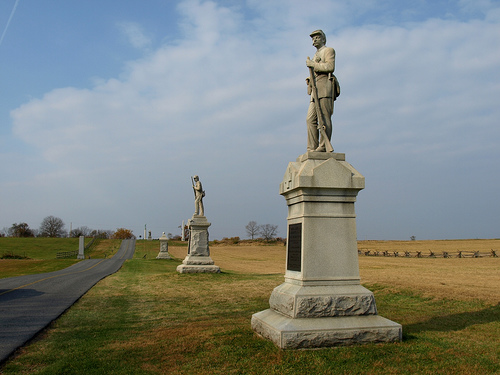
 According to Brian Schoeneman it does. That name might right a bell for regular readers of CWM. On occasion, Brian has commented not so much on the content of my posts, but on my handling of various discussion threads. Brian is a candidate for Virginia House of Delegates in Fairfax, Virginia. Recently he toured South Mountain, Harpers Ferry, and Antietam with Scott Manning. As a campaign promise, Brian promised the following:
I asked Brian if he was surprised at the lack of Confederate monuments. “Actually, I am. It kinda annoys me. There are about a zillion Union monuments here. Granted, the North took more casualties at Antietam, but they had more guys to lose.” He recalled one of the informational markers he read, “The Army of Northern Virginia lost about a quarter of their strength and the Army of the Potomac lost about an eighth. It was much harder for the South to replace those casualties than it was for the North.” Brian clarified that, if elected, he planned to introduce legislation next year to place a Virginia state monument on the battlefield in commemoration of the sesquicentennial. I pointed out that such a move could backfire if not done properly and he interrupted me, “There’s nothing political about recognizing that folks in the army of the state that I’m from fought here and died here. They deserve to be remembered regardless of what side they fought on and it bothers me there is nothing here, because I know there are plenty at Gettysburg.”
First, it becomes political the moment you couch the goal in the form of a campaign promise. Such a promise also opens up a heated debate over whether the National Park Service ought to allow new monuments to be placed on the battlefield. I know at one point there was a moratorium on additional monuments. The Save Historic Antietam Foundation has been very vocal over the need to preserve the battlefield from continued encroachment, both in the form of commercial development and the ground itself. Tom Clemens, who is the organizations founding member, has consistently spoken out again the placement of additional monuments as a form of preservation.
Antietam is by far my favorite Civil War battlefield. It’s where I was first introduced to the subject back in 1994. I for one would hate to see the battlefield overrun with additional monuments that reflect both legitimate themes of remembrance and more nefarious motives.
So, does Antietam need a new monument?
[photo credit]
I have been visiting the Antietam Battlefield for years and was really surprised when I read all the or some of the comments about the South not having enough monuments at The Antietam Battlefield. Especially, when the monuments were supposed to have been placed by asking the veterans who had fought in a particular spot on the Field. This just is not right, those men fought there for what they believed in. I do not like making negative comments about the Antietam Battlefield because I love the place but something is amiss. By the way as some of you may know Georgia has a fairly new monument just below the Texas Monument at Antietam along the Cornfield Road.
Placing a monument on a National Park Battlefield is a piece of work. I know I have been involved in a few as a sculptor and project coordinator. However, it can be done even with the moratorium in place. Wide project support is the key. If it is a state monument, support from within the state government is imperative. Beyond that, support from the reenactors, soldiers relatives and historians in general. Dedication to the project fullfillment is the key to ultimate success. And yes, I agree, Antietam is overrun with Yankee monuments.
And yes, I agree, Antietam is overrun with Yankee monuments.
You mean monuments that commemorate the United States of America?
The ban by the NPS is not to restrict Confederate monumnets, but all new monumnets. In fact our organization, Save Historic Antietam Foundation, vigorously opposed the last monument placed, the Irish Brigade monument for the same reasons we opposed the new Lee statue that went in on private property. In part because new monuments are not expressing the desires of the veterans, but the opinions, however well-intentioned, of modern people. When does this stop? Do we keep allowing successive generations to immotraize their various heroes as they see fit, forever?
This Mississippi monument has followed Mr. Chaney’s model for the Lee statue; it is not going on the NPS land, but on private property surrounded by NPS land. In other words they are stating that the NPS does not control the intepetation of the field and they will put up their monument to whomever they think is important, in direct opposition the the NPS plan. I find this an alarming trend. Shall we let “inholding” properties become monument farms to the popular figure of the day, week, month, etc.? Who should control the history of the battle and how its story is told? Admittedly I do not always agree with the way the NPS interprets the field, but opening it up to the whoever has the most money for monuments is not a viable solution.
Thanks for chiming in on this one Tom.
Nice thought. I think I like the idea of monuments being limited to the first generation of commemoration, by the veterans and their groups. There is a physical space limit and frankly some older preserved Civil War battlefields look like ripe fields of granit and marble. First generation monuments are historic artifacts as well but enough is enough.
To paraphrase Dan Sickles, the entire battlefield is a monument to the soldiers who fought there. If this man wants to honor the folks who fought there he can come up with some money for battlefield preservation. He can help buy some land or protect the land the park already owns. If, instead, he is determined to spend precious dollars on a new monument to the Virginia soldiers, then that monument may some day be in the parking lot of a Walmart.
Antietam NP or Shaprsburg as we Southerners know it as, IS receiving a new monument in the near future.The latest is to honor the 11th Mississippi Inf. I recognize the fact we need to have some control over “monumental expansion” within the NPS because of viewshead, etc. However, I also feel there is a lack of respect to the Southern people and their history with the current NPS monument moritorium approach. It was not until much later after the war that some southern states were financially able to honor their ancestors with a monument on the battlefields. Now, they are restricted totally, very alarming! While this is one issue, what of the fact that to the common tourist visiting the battlefields, monuments are the troop location indicators. So where were the Southern forces, no monuments, no battle understanding, therefore a loss of history and education!
The ban is not intended to limit the number of Confederate monuments, but as you note, to preserve the integrity of the landscape itself. To say that this somehow discriminates against Southerners is completely unjustified. Your claim that this moratorium somehow limits understanding of the battle is also a bit of a stretch. As you well know, there are plenty of detailed military studies, guidebooks, and NPS guides to help visitors make sense of what took place.
I am a bit surprised that you are not aware that Antietam Battlefield has more than 300 War Department tablets that mark the position of the Corps (or Commands for the Confederates), Divisions, Brigades, and individual regiments for both sides. As well, they offer a narrative for ‘battle understanding’, something the monuments don’t. BTW, where can I get information about this new Mississippi monument?
If he wants to honor the Virginian soldiers who fought at Antietam he should donate some money to buy land, or that shiny new Virginia monument he is so keen to erect could be in the parking lot of a Walmart.
The beauty of Antietam is the amount of wide open space NOT obstructed in view. I agree with those who would rather protect more LAND so that future visitors can truly get a picture of how this battle evolved. Placing monuments for every state involved? How about one marker/exhibit near or at the visitors’ center, and I agree with my daughter- update the film! As a non-historian visitor, I view the battlefield from a truly tourist view and any other monuments, which will inevitably lead to more requests, will depreciate the tourist/visitor’s understanding. Btw my father is from Virginia.
Dr. Tom Clemens is right on and so is James Epperson. Brian is completely overlooking the important fact that NOT ONLY did the various vets of the battle pay for the land and monuments, they also accurately PLACED them at the locations marking their furtherest point of advance. In addition, the Antietam Battlefield Board (1890s) involving VETERANS OF THE BATTLE interviewed thousands of other veterans from both sides to insure the accuracy of the war department tablets, the 14 maps based on ea. hour of the battle, etc. to insure that future generations would have as COMPLETE and ACCURATE assessment in place as attested by the people WHO WERE THERE.
To my knowledge, there are only 3 exceptions to the monuments placed by the veterans of the battle and they were placed at the time of the centennial celebration in 1962. On Cornfield Ave., the states of Georgia and Texas placed monuments less than 100 yards appart to commemorate their losses. The 6th Georgia and the 1st Texas regiments lost 90% and 82% of their units (respectively) in and around THE cornfield. At the same time, the American Red Cross also erected a very modest monument on Mansfield Ave. to commemorate Clara Barton’s work in that end of the battlefield.
Sorry, Brian but Antietam does NOT need anymore monuments. It’s a pristene battlefield with appropriate references and very well maintained by the NPS folks. As a volunteer, you wouldn’t BELIEVE how many people (from north, south, east, west) tell me that on a weekly basis. They like the fact that there are “just enough” monuments to tell the story. If you wanted VA monuments at Antietam, than Lee should have won a decisive battle (there) but he didn’t. You want to do something great for Antietam? Help the continued effort to restore the East, West, and North Woods and some of the historical structures that are under restoration.
Monuments, by definition, memorialize “something” – they are not interpretive markers (which, obviously, become contested over time, and all the time…)
By extension, if they memorialize “something” then they are being erected for an ideological purpose, as opposed to an explanatory one.
When the genesis of the memorialization effort is something as clear as “there aren’t enough monuments to MY state, region, group, etc” it is disengenous to deny a political motivation to the effort.
As an aside, are there no West Virginia monuments at Antietam?
Best,
I suspect there is no danger of any wave of new monuments. From a practical standpoint, the amount of money to raise a professionally executed monument is not easily raised. States who can’t keep basic services funded are not going to be in a rush to contribute and private individuals who could are more likely to fund (hopefully) preservation of land than monuments.
The biggest drawback I see to new monuments is deciding whether one was appropriate in terms of size and design. Monuments erected by veterans or the following generation reflected their ideas of what was appropriate, a luxury we no longer have.
I don’t have a problem with new monuments as long as they aren’t intrusive (out of proportion to existing monuments), but I suspect they aren’t a wise use of resources or much of an addition to what are already national treasures.
While I’m not as learned as many whom have posted, I sure dont see a monument cant just state “dedicated to Virginians who fought here on both sides, north and south” instead of being an unwieldly project. I am very political and consider myself 1000% Yankee. I am a member of the CWT and dedicate some of my time cleaning up battlefields every spring. I see nothing wrong with monuments and feel they add to the allure of the battlefields.
I agree, monuments, even a plethora of them like at Gettysburg don’t offend me and actually I like them.
But then I mourn the needless destruction of the National Tower at Gettysburg and I’d be happy for there to be one at all of them.
Brian,
I’m afraid that your comparison of my statement to your breakfast at IHOP, though certainly comical, is a bit of a straw man argument. I did not say that anything done during your campaign is a political action. I said that erecting a monument at Antietam, by making it an objective if elected (or, as you put it, “simply something that I would like to do if I have the honor of being sent to Richmond by the voters in Fairfax.”), ties it to your own politics in the strictest sense – as part of your ongoing campaign. And, as Kevin says, best of luck in that regard.
But that’s beside the point. My larger argument was that monuments themselves are inherently political – they are erected by a particular group of people, for a particular purpose, often to serve or address contemporary concerns. See the 1960s-era Confederate monuments at Gettysburg for a classic example (not that I am making a comparison between the intentions of your efforts and theirs, mind you, just an example of my larger point). In short, monuments have meaning. Now, certainly, that meaning is neither universal nor immutable. You are absolutely correct in pointing out that different visitors would take away different meanings from a memorial of any type. But that also proves my very point – memorials are contested spaces where those different interpretations and understandings of the past (and their meaning(s) for the present) are debated. Perhaps you can see that our definitions of “political” in this instance aren’t that far off.
Now, let me move more specifically to a monument at Antietam. First, let me offer my apologies for misrepresenting your intentions regarding who the monument would commemorate. I made that assumptions based on the context of the quote that started this discussion, which seemed to indicate your interest in commemorating Confederate Virginians. (See: “I asked Brian if he was surprised at the lack of Confederate monuments. “Actually, I am. It kinda annoys me. There are about a zillion Union monuments here. Granted, the North took more casualties at Antietam, but they had more guys to lose.””) Perhaps that quote misrepresents your position, but such it is.
But, perhaps my assumption can also shed some light onto a larger concern here. You have said this monument would need no interpretation, no text. That it could simply stand as a memorial to all Virginians – white and black, Union and Confederate – at Antietam. That is certainly an idealistic stance. Unfortunately, offering no explicit interpretation could very well open up such a monument to even more controversy. Many will simply assume, because it’s a Virginia memorial, that it is to Confederate Virginians. Quotes like the one in the previous paragraph will only further this assumption. Others might attack any memorial dedicated, even if just in part, to members of the former Confederacy, given what those Virginians stood for and who they were fighting against. The need to commemorate those men is a value judgment on your part, which others will inevitable disagree with, perhaps quite vocally.
There are also a whole host of practical concerns that would effect how members of the public see and interpret this hypothetical monument. Where would it be located? If it’s not a Confederate memorial, it certainly cannot be near the Confederate lines. What would it look like? A mere obelisk with no text, for example, would fall into a well-established tradition of military memorials from that era, but then many of members of the general public would assume it is yet another military memorial – and, being a Virginia memorial, therefore Confederate. Statuary on the memorial (like the statue of General Lee on the Gettysburg Virginia memorial, to which you refer elsewhere) would also influence the interpretations of and reactions to the monument. A statue of Lee, erected today, would certainly spark controversy in some parts of the public; a statue of an escaped slave fleeing to Union lines would arose controversy in others. All would influence the way members of the public interpret the meaning you are intending to portray through such a memorial.
I could go on, but to return to one last point for now – the Vietnam Memorial. It is an excellent memorial, but, despite your belief that it is somehow apolitical, it is also a textbook example of how memorials are contested spaces, where a range of interpretations will compete over the meaning of a monument. And I mean textbook quite literally – there are books and countless articles written on the years of controversy surrounding that memorial. Not all of these resources are related, but you get the point: http://digital.lib.lehigh.edu/trial/vietnam/resources/ . It is because of these controversies that the monument expanded to add the three soldiers statue and the women’s memorial. So yes, the monument doesn’t literally say a word in judgment on the war – in that you are correct – but that did little to assuage the huge public controversy (the politics of memorialization, I would argue) that enflamed passions during the entire process, as members of the public offered differing and conflicting interpretations of the monument’s meanings – intended and unintended.
Perhaps this clarifies why a memorial relating, in large part, to another controversial subject – the Confederacy – cannot be without its own controversy – read: “politics.”
Fair enough, Will. I can see how you got where you went from the quote I gave Scott about the dearth of southern monuments on the field. I probably should have expressed myself better – I simply wanted something similar to the Texas monument. And that monument, as you noted, was put up in 1964, the same year the Civil Rights Act was passed. So I can see why you went there.
I’m no lost causer. I’m just a Virginian. If you read over the posts I’ve made on my blog concerning the war and the sesquicentennial, you’ll my stance on secession and its impact on Virginia – one of the worst decisions we ever made, and I’m proud that the delegates from my area voted against it during the Convention.
I know that this idea will end up being controversial, simply because it has a price tag attached to it. But I don’t think it has to turn into the same old debate about slavery and glorifying the Confederacy because that’s not where I want the focus to be. When it comes to a war monument, it should be about the soldiers and what they did, not about their motivations. Recognizing that Virginia lost hundreds of citizens at Antietam and erecting a monument to their memory doesn’t have to be the starting point for yet another tired debate about the war, its causes and its justification.
I don’t have any ulterior motive here. I like visiting battlefields. I like visiting monuments to Virginia when I go. I think many of my neighbors do too. I’d like to see one at Antietam. I was surprised that there weren’t more. That’s all.
Brian,
Thanks for your response. It is always wonderful to see a politician with a healthy interest in understanding our history and learning from both the successes and the mistakes of our past. We can always use more of that in our political system.
I think our fundamental disagreement is over this point: “When it comes to a war monument, it should be about the soldiers and what they did, not about their motivations.” Separating war from its causes, or soldiers from their motivations, is, in my opinion, a dangerous proposition – if it is at all possible in the first place. Obviously there will be some political fallback in trying to separate those Virginians who did fight for the Confederacy from the reasons they were fighting and who they were fighting against. That is just the nature of the beast, today. The question will inevitably be asked: if their cause was wrong, “one of the worst decisions we ever made,” why does it deserve commemoration at all?
Such a statement also falls into a long tradition of CW memorialization and remembrance. David Blight’s Race and Reunion, if you haven’t read it, might shed some light on some of the historical implications of CW commemorations that, in the fifty years after the war, ignored the “why” in favor of commemorating all participants as “good soldiers.” I highly recommend this book, especially to someone with your interests.
And, in a larger sense, it is dangerous, in my opinion, to commemorate any war apart from its historical context – the “why” factor. Perhaps this is the historian in me coming out, here, demanding everything be put in context. Certainly much of this is personal sentiment, which questions the value and worries about the implications of trying to separate war/soldiery from its motivations. And part of me wonders what kind of service it does to commemorate the men who experienced the horrors of Antietam while glossing over why they were there in the first place. Just some food for thought.
Best,
Will
Thank you for stating that position so well. We have been trying to focus our museum visitors on the context of Lincoln’s Life and the background leading to the Civil War. Commemoration activities try to create a simple statement while history is messy.
Tom
Will,
Monuments placed on historic sites by the generations following the veterans themselves are much more about the people who chose to commemorate than about the subject itself. To suggest otherwise is to fail to understand the nature of commemoration itself.
Kevin,
I said something similar earlier in this discussion: “monuments themselves are inherently political – they are erected by a particular group of people, for a particular purpose, often to serve or address contemporary concerns.” I would argue that this even applies to the actions of the veterans themselves, as part of the post-war reconciliation movement.
That being said, monuments do still offer a particular interpretation of how the dedicators believe society should remember an historical event or individual – certainly in relationship to the contemporary context in which the monument was erected, but an interpretation nonetheless. 1960s Gettysburg is a classic example, here. In this particular case, I question whether we can memorialize Virginians at Antietam – particularly Confederate Virginians – as simply soldiers apart from their motivations. What meanings from the past, some intended and some perhaps not, do the sponsors of such a memorial pass on as the important lessons for a modern audience?
Will,
We are definitely on the same page. It seems to me that the central problem is that there is no way to control how monuments are interpreted by the general public. Anything involving an elected official adds just another layer to that identification and one that all too often leads to conflict. Even if a monument does not include a specific reference to a cause its very presence lends itself to reflection on just those issues. Being told that the monument was not meant to open up such reflection is itself a commentary on those very issues.
Kevin, I agree 100%. I would also add that another major problem with monuments is that they must, by their very nature, simplify a complex history. They are, as a result, inherently selective in the manner in which they interpret the past for the present. This has already been pointed out, but I thought I’d reinforce it here.
However, I would also argue that erecting a monument is not the only way for Brian to give Virginia more of a “presence” at Antietam. Sure, monuments have high visibility (and publicity), but perhaps he could use his position as a politician to push for preservation and improved interpretive/educational programming. What better way to ensure the public is able to see a fuller picture of 1860s Virginians? Is that not the ultimate goal?
Stay tuned, Will. I am actually working on a post that addresses the issue of education and commemoration.
I think you are confusing soldiers motivations for their side’s cause.
they can be and usually are quite different.
Most CSA privates were in the army for one of two reasons, social pressure on the home front or they were drafted and not for any political reasons,
The SCV and their Libertarian allies are doing the memory of the soldiers a great disservice by using their memory as a pawn for their modern political agenda..
I don’t think these choices were necessarily mutually exclusive. We should distinguish between why soldiers initially enlisted and what kept them in the ranks.
Thanks Kevin for posting this discussion. As you stated, SHAF does oppose any new monuments at Antietam. Questions of “balance” and who deserves monuments and who doesn’t become inherently political. Where do you draw the line? Mr. Shoeneman wants a “Virginia” monument there. Is he suggesting every state that doesn’t have one there should be allowed? What about counties? Individuals? Dependent who has the money and political connections? Is Mr. Shoeneman aware of the Lt. Chamberlayne, 6th Virginia monment at the entrance to the Piper Lane? Does that not count as a Virginia Monument? We at SHAF, and the administration at Antietam, believe the battlefield should reflect the veterans wishes. Those men who fought here had a huge role in deciding how the field should look. They put heir monument wherethey wanted them. It is presumptuous of us to assume they omitted something that we now need to address. And it gets down to, eventually, what unit, state, brigade, is “popular” now. There would be lots of enthusiam for monuments to the Stonewall Brigade or the Iron Brigade, (the western one anyway, few know about the original Iron Brigade which also fought in the cornfield), but what about the other brigades? Are they less deserving? Do we erect monuments to them all?
Also, the Virginia veterans had the choice of what they wanted to commemorate. Rather than erecting monuments on battlefields in the north where they lost the battle, they CHOSE to erect monuments in nearly every county court house square to teh Confederate dead. This is often the case with losing sides in a war, go to Europe for example. If “balance” is desirable on a battlefield, why not in the court house square? Shall we erect Union markers in every Virginia county in the name of “balance?” I say no.
Finally, I will annoy 90% of your commenters with this observation: There are currently two monuments at Antietam to that famous Virginian Robert E. Lee, whose army lost the battle. If anything is missing it is that there is no monument to the man whose army won the battle. How does Mr. Schoeneman feel about a McClellan monument?
Thanks for chiming in on this one, Tom.
Tom, I agree with you, 100%. As a local from the Sharpsburg area, I agree that the last thing antietam needs is another monument.
If you want to recognize Virginia, donate money to update the documentary film they show at the visitors center (talk about historic) with the tagline “Brought to you by the great state of Virginia.”
Tom, I appreciate your comments. I do think that each state that contributed soldiers to the forces on both sides should have the opportunity to place a monument. I don’t believe we need to go to the level of counties or individuals, because acknowledging a state itself covers the counties (which are simply extensions of the state) and the citizens of those states.
You have to admit that it’s equally presumptuous to assume that because there were few southern monuments on the battlefield that was strictly due to the wishes of the veterans at the time. The Rangers at Antietam told us that following the war southern monuments weren’t permitted or were strongly discouraged from erecting any. Coupled with the economic damage the south faced, being able to scrape together the money to build a monument like this was not always possible for those veterans. I think it’s hard to justify the argument “this is what they wanted because this is what they did.”
If Pennsylvania or New York wanted to erect a monument on a Virginia battlefield where they lost, I’d be fine with it. And my only issue with a McClellan monument would be based on a dislike of his command style, not with the fact of balance.
I understand the idea that the battlefield should reflect the veterans wishes. At the same time, the government holds that land in trust for the American people and for the benefit. That shouldn’t be forgotten, either. I think a monument would enhance, not detract, from that benefit. We can agree to disagree.
There will be a Vermont monument unveiled this weekend at Bethel Park in Hampton where the yanks got whupped real bad at Big Bethel 150 years ago today. Put ’em up and honor your ancestors. Y’all who oppose the Virginia monument idea from Mr Schoeneman should be flat out ashamed.
Billy,
Please do not mistake my opposition to Brian’s idea to be specific to this one instance. I am opposed to any monuments posted by people who were not there at the time of battle.
Will, I think your definition of “political” is overly broad. If anything that I say is inherently political simply because it occurs within the context of my campaign, you’re basically saying that when I ordered a ham and cheese omelet this morning at IHOP during a campaign meeting, it was political. I suppose that may anger the vegan vote out there, but it’s hard to find anything overtly political about breakfast. Regardless, when I meant political in my above comments I was using it a synonym for partisan and controversial.
When done the right way, this monument doesn’t have to be partisan and it doesn’t have to be controversial.
Nowhere did I say we should be erecting a monument to “Confederate Virginians.” My point about erecting a monument was based on the fact that soldiers from the Commonwealth fought at Sharpsburg – definitely on the Confederate side, but just as possible on the Union side. George Thomas wasn’t the only Virginian who stayed loyal. And there were plenty of Virginia slaves who made their way north and contributed to the Union war effort, as contraband and others. That’s why I would suggest the monument simply be a recognition of men from Commonwealth being at Antietam, not a recognition of any specific unit or individual.
Personally, I think the best monuments are the ones that commemorate but don’t make overtly political statements. Look at the Vietnam War Memorial – one of the best out there, in my opinion. It doesn’t say a word about how controversial the war was, doesn’t argue in favor or against it. It simply lists the names of those who died and does so in a dignified and memorable way. There’s no reason why a Virginia monument can’t be similar in that regard (although not in shape or form, obviously). Some would view the monument as a recognition of their ancestors. Others could view it as a memorial to the folly of secession and the failures of the politicians at the time to avert the worst war in our history. Others could view it as simply a recognition that Virginia was there. Everyone can take away what they want from it.
I believe that a commemorative act of this nature doesn’t have to be political – meaning it doesn’t have to be partisan, it doesn’t have to be divisive and it doesn’t have to be wildly controversial. Perhaps that’s my idealism showing through, but I think its possible for us to remember these things without trying to glean some kind of modern partisan message from them.
I went to Antietam. I expected to see a Virginia monument. There aren’t any. I want to fix that. It’s just that simple.
Hi Brian,
First, I forgot to wish you luck with the campaign. I admire people who choose to get involved in public service and you seem like a good guy.
You said: “Nowhere did I say we should be erecting a monument to “Confederate Virginians.” My point about erecting a monument was based on the fact that soldiers from the Commonwealth fought at Sharpsburg – definitely on the Confederate side, but just as possible on the Union side. George Thomas wasn’t the only Virginian who stayed loyal. And there were plenty of Virginia slaves who made their way north and contributed to the Union war effort, as contraband and others. That’s why I would suggest the monument simply be a recognition of men from Commonwealth being at Antietam, not a recognition of any specific unit or individual.”
I don’t understand this paragraph. Why do we need a monument that is vague as to which Virginians fought at Antietam? No black units were present so we don’t have to worry about African Americans unless we look for the ever elusive black Confederate. 🙂 How would you propose looking for Virginia unionists who may have ended up in a Union regiment? That seems like an unwieldy project. In the end, we are talking about Confederates, who served in specific units. Why avoid that fact?
Thanks Kevin, I appreciate the best wishes.
The primary reason I think it would be best to keep it vague is simply to avoid the kinds of issues we’ve already seen here in this thread alone. I think the argument over whether this is a “Confederate” monument can be avoided if we simply acknowledge folks on both sides. I’d have to leave the research on Virginia born Union soldiers to the historians like you, but I think it’s safe to say that they existed. But your point is valid – in the end, the vast majority of the folks who fought for Virginia at Sharpsburg were Confederates. But I’m less interested in remembering them as Confederates than I am in remembering them as Virginians. It would be a Virginia monument, not a Confederate one. That’s really my point.
Mr. Schoeneman, while I am inclined to support a “new” monument, I don’t think keeping the subject of the monument vague would be positive. I’ve studied and cataloged monuments on more battlefields than I can count. What makes them a “monument” over a “memorial” is that the former direct our attention to specifics – what a certain group of men did at certain point on the ground at a certain time in history. I would offer a very recent addition to the Spotsylvania battlefield as a good example of one done in a fitting manner – McGowan’s Brigade ( http://www.hmdb.org/marker.asp?marker=19073 ).
At Gettysburg, I often call attention to the Pennsylvania monument. I consider it the most fitting and important monument on the field. Not because it is the largest or has the best architecture. But rather because of the plaques listing every man, by regiment, from the state. On every visit to the battlefield (and there have been many), I’ve seen someone looking up names on the wall. Words may carry meaning, but names are connections.
To quote Mr. Schoeneman: “There’s nothing political about recognizing that folks in the army of the state that I’m from fought here and died here. They deserve to be remembered regardless of what side they fought on and it bothers me there is nothing here, because I know there are plenty at Gettysburg.”
That statement is, itself, political.
Erecting a monument to Confederate Virginians at Antietam, especially in this day and age, is political. On the most obvious level, as Kevin has already pointed out, making a statement in favor of such a monument during one’s campaign as a Virginia politician makes it political. One the more subtle level, the meanings, intended or not, that may be taken from the monument and its dedication will make it a political effort – all monuments, in fact, are tied to some broadly defined notion of “politics.” They are, at their core, erected for a purpose that is intended to give them meaning to contemporary society – that act is, again, in its very nature political.
Take, for instance, Mr. Schoeneman’s comment that the monument does not even need to have text, thereby supposedly avoiding it being seen as a political act. But simply choosing not to mention what those Virginians were fighting for is a conscious decision that will not be free from controversy. Think Gov. McDonnell’s proclamation of Confederate History Month a year ago. How, one might ask, does Mr. Schoeneman think black Virginians would see the dedication of a Confederate memorial at Antietam? Would they concur with his opinion that Confederate Virginians deserve to be remembered, regardless of the side they fought for? A monument that mentions slavery will be seen by some Virginians as an appeal to “political correctness”; a monument that fails to mentions slavery will be seen by others as a thinly veiled appeal to the Lost Cause – even if that is not its intention.
And that doesn’t even touch on the potential political implications of commemorating, 150 years after the fact, men from “the army of the state that I’m from” who fought against the Union of which we are all a part today. Whether Mr. Schoeneman intends it or not, many will see this as casting a sympathetic nod towards the Confederates and their cause, asking instead why they are worthy of commemoration at all. It is a judgement call and an opinion on his part, not some universal belief.
To believe that a commemorative act of this nature can be free from political implications simply fails to acknowledge the responses surrounding similar commemorative actions in recent years and the very nature of what monuments, in particular, stand for.
I’m not sure I disagree with Brian Schoeneman. In fact, I may find myself more in agreement than disagreement, provided we can reach common ground. I think his proposal has to be placed in context, and “what kind of monument?” is a good question.
Yes, I think the purchase, control, restoration, and preservation of land comes first. Otherwise, you have Salem Church as a result. So I would support battlefield preservation first and foremost. That said, however, I will point out that there have been more monuments added, including one just two years ago at Spotsylvania (I know this because I saw it a few weeks ago, and it wasn’t there two years ago). It was a monument to a South Carolina brigade at the Bloody Angle. So long as these monuments were constructed according to standards designed to make them compatible with what’s there, I’m not sure what the problem is. It’s when the monument doesn’t fit that problems result. For example, I like the John Gibbon monument at Gettysburg because it fits in with the other monuments; I’m a little less enthralled by the monument to Samuel Crawford (it’s the flag), and even less happy about General Longstreet, although I prefer it to several of the Confederate state monuments (Mississippi and Louisiana), which suggest that there were no shoes in creation that could have shod those soldiers.
You will recall that I’m married to a descendant of North Carolina Confederates, and yes, I do visit the North Carolina monument at Gettysburg to think about what they went through on July 3 (one of her ancestors was wounded in the Trimble-Pettigrew-what’s-his-name-with-the-curls charge that day). So I don’t begrudge Brian his reasoning, much as I visit the markers to the regiments in which my ancestors served, the 146th NY (at the base of the Warren monument) and the 23rd PA (near the traverse on Culp’s Hill … note how everyone was nicely separated). Perhaps something could be worked out where in exchange for permission to put up a monument that fits in with the park’s standards the state or organization involved makes a significant contribution toward preserving part of that battlefield.
Yes, I understand the arguments here, but I for one simply don’t dismiss Brian’s thinking or his sentiments.
I am certainly not making a blanket claim against any future additions of monuments to Civil War battlefields. Many people still have a deep need to remember and commemorate the war and monuments represent one form. That said, I do worry about the lifting of a moratorium at Antietam for reasons that have already been expressed.
That said, for some reason I tend to be less impressed with more recent additions to battlefields regardless of the unit. I don’t really know why, but perhaps it an assumption that the first generation of monuments are more meaningful and somehow have more legitimacy. Later additions often strike me as attempts to address some perceived lack of balance and less about the men themselves. Of course, that’s not always the case, but it is present in my thinking.
I know exactly what you mean concerning new versus old. The older monuments have become historical attractions, as they tell a story of those closest to the war that toiled to plant them. Although I have seen some decent newer monuments, they lack the story of their older counterparts. Of course, 100 years from now the new monuments will be historical for different reasons to a new generation.
That being the case, I don’t see the harm in opening up the idea for discussion. Yes, there have been some recent mistakes in my mind, but some nice additions as well. For example, I was pleased to find some relatively recent monuments to Union forces at Cold Harbor during my last visits there; I am somewhat divided about the monument to the 140th NY at Saunders Field, because, frankly, there were other Union regiments there, an impression you get from the NPS wayside marker by the shelter but not from the monument. Some Union regiments have three markers at Gettysburg (for July 1, 2, and 3); most people don’t know that the 1st Minnesota has two monuments at Gettysburg (one due south of the monument to the 20th MA as well as the better-known one for July 2), and Strong Vincent has, one way or another, three markers on the southern part of Little Round Top (two places marked by veterans at the time and the “unnamed officer” at the top to the monument to the 83rd PA).
That said, I’m also well aware of the nature of some of the Confederate state monuments erected at Gettysburg and the way in which they serve to craft a certain message about the war. I just think there might be some creative ways to discuss this in a constructive manner.
I couldn’t agree more with the overall thrust of your comment. I have nothing against opening up the subject for discussion, which was my intention.
The one thing that hasn’t been brought up is the possibility of commemorating the ground via some form of digital technology. Both you and Brian have suggested that objects such as monuments have the potential to draw us to specific locations on battlefields. Without having thought this through it seems worth suggesting that such an object could take on a non-physical form such as a mobile device that includes narrative, images, etc. Mobile devices are already being utilized. It is conceivable to imagine such a device bringing visitors to various places on a battlefield where units from individual states (even localities) fought. Just a thought.
A point that needs to be made about the Longstreet monument at Gettysburg (aside from the fact that it was the first monument to him on a CW battlefield) is that the statue (a different design) was originally approved before WW II. Longstreet’s widow and veterans of the First Corps ANV were involved in the original project.and participated in a groundbreaking. World War II intervened. Things like bronze were needed for things other than statues, and Helen Longstreet donated all the funds raised, except for a small amount used to erect a large marker on his grave, to the war effort. That is why the statue was not affected by the monument moratorium at Gettysburg.
I understand Bob Huddleston’s point, but I think the project with its massive, broad-based public involvement (the turnout for the dedication was amazing) brought far more people and money into the cause of battlefield preservation than would have been gained had he directed his contribution elsewhere. I think the whole process enlightened a lot of people as to the deleterious effect that the Lost Cause had on the historiography of the Civil War and the need for accuracy, fairness, and thoughtfulness in the writing and discussion of history. It was always made clear by the Longstreet Memorial Fund (LMF) committee that we weren’t there to try to deify/Jacksonize Longstreet: The struggle was for fairness and accuracy with his virtues acknowledged and flaws & mistakes dealt with accurately without demonization.
As for the site, the LMF chose from the options provided by the NPS (the original site was no longer available due to NPS policy changes).. The site chosen, while visible from the road, is nevertheless sheltered, does not impinge on the viewshed, and is in an area that was already disturbed.
I suppose I’m one of the few who actually likes the Longstreet monument, but I am completely with you on the enormous feet that look more like hands on the Louisiana and Mississippi monuments. Having said all that, I really don’t see anything wrong with adding a Virginia monument at Antietam along the lines Brooks has laid out and as long as historically valid, by which I mean placed in the vicinity of where the Virginia troops would most likely be found (within park boundaries, of course) and doesn’t detract from our understanding of the battle, the war, or the contributions Virginia troops made. Any thought to including Virginians who fought for the Union as well?
Kevin, I appreciate your post here, and I thank you for mentioning the interview Scott wrote up for his blog. We had a fun trip out to South Mountain and Sharpsburg and it gave me a chance to take a breather from the campaign and work for a little while.
When I visit Civil War battlefields, I enjoy seeing the lay of the land, reading the historical markers and visiting the various monuments that exist. I used to live in Pennsylvania and visited Gettysburg often. Now, I live fifteen minutes away from Manassas (when the traffic isn’t bad). Gettysburg has a significant number of monuments and I don’t believe they detract from the overall experience of visiting the field. In fact, I think they enhance it. I always seek out the Virginia monument when we visit Gettysburg, and I know that many folks do the same thing. Visiting a battlefield and seeing a monument to the folks who fought from your home state gives people an additional connection.
That’s why I was surprised and saddened to see that there were very few southern monuments at Antietam. Contrary to James’ assumption about my level of knowledge, I’m fully aware that most monuments were funded by veterans groups following the war. But as he notes, many states have put up monuments as well, and I think those are appropriate. The Texas monument in the Cornfield appeared to be of relatively recent placement, and I thought it was tastefully done. A Virginia monument can easily be accomplished in a similar way.
And no, it doesn’t have to be political. I’m not naive – I’m a politician after all – I simply disagree that it has to become some kind of embroglio. It’s a marker to commemorate Virginia’s role in the battle. It doesn’t have to be political. It doesn’t even have to mention the Confederacy. It doesn’t even have to have text on it at all. It only becomes political when people want to make it political. I’m surprised to see folks in this community object to something like this that can only help increase awareness of history. Then again, one of the issues I’ve had with some of the folks on this blog is the nose-in-the-air belief that one can only truly appreciate history by being an historian.
We don’t need to inject politics into everything related to the Civil War. It’s unfortunate that this happens. The Commonwealth of Virginia lost a considerable number of its citizens during the war in various actions across the Eastern theater. I think we owe it to the memories of those who fell to remember them. A monument does that, and in a visible and physical way. It can provide Virginians who visit these sites – a place to visit specifically, like I wanted to do at Antietam and have done at Gettysburg. I can’t believe I’m the only one who has ever felt that way.
And just to clear things up, my comment to Scott wasn’t a “campaign promise.” It’s simply something that I would like to do if I have the honor of being sent to Richmond by the voters in Fairfax. There’s a lot more thought that has to go into it – from whether we can get NPS to allow a new monument to be erected, to who designs it, what it says (which should be as non-political as possible), and how much it costs, whether it’s a public/private partnership and so forth. Perhaps we put up monuments elsewhere, too.
As for conservation easements, I consider myself a conservationist and I believe in protecting our battlefields. That being said, I don’t consider monuments to be a blight. They add, in my opinion, not detract. Of course, you need moderation and some tastefulness, but if done right they are a benefit, not a detriment.
I’m sorry you guys disagree with me.
The Texas monument has been there every time I’ve visited Antietam, which first occurred in 1979; I would guess it was put up in the 1960s.
Right you are James. The Texas monument was placed on the field at Antietam by the State of Texas in 1964. It is made of native Texas red granite and stands out among most of the other monuments due to its color. All Texas Civil War Monuments outside the state are made of native red granite.
Sir, I actually agree with you. I was just at Antietam on Monday 6/25 and was saddened by the lack of Confederate monuments while there are more than enough Pennsylvania monuments on the battlefield. I was also disgusted to see several civilian homes in the middle of the battlefield. Why are these places not sacred? Men fought and died on these lands and we modern day citizens seem to think very little of it. The South was left broken and destitute after the war and there was no money to erect monuments to the brave dead.
I’ve read several comments here about slavery, etc. and it saddens me that our public school systems do not teach the truth about the South and the reasons for the war. Yes slavery was a part of it but it didn’t become the main reason behind the war until Lincoln started to lose support for the war. The war, on the South’s part, was due to something similar to what’s happening today — big government interfering with State sovereignty. Here is some information I doubt many of you know — Lincoln had no plans to move freed slaves to the North but was planning to send them back to Africa. There were more abolitionist or anti-slavery groups in the South than there were in the North before the war. The largest slave owner in the South was a free black man in Louisiana. Most overseers were free blacks. The majority of slave owners in the South lived, ate, slept and worked along side their slaves. If the South was such a bad place, why didn’t more free blacks leave for the North or find a way back to Africa?
Melissa,
The South was indeed destitute, but they did manage, by the time most Antietam monuments were erected, to put up monuments in most county court house squares to the Confederate dead. This in itself is not surprising, it was the memory they wanted to cherish, and why would they go up north and put up monuments on battlefields where they lost?
Indeed the in-holdings of private houses is an outrage to me too, but unless it starts raining money sometime soon, do not look for it to change. Federal budgets for the NPS are being cut, Antietam laid off staff this year, and next year looks worse. I had a long talk with theAntietam Supt. last week, and it looks grim. Write to your congressional delegation with your concerns, it does help.
Yes, I did know about Lincoln supporting repatriation of blacks; it was his most politically viable stance. I have not heard there are more abolition organizations in the South than the North, and would like to know sources for that statement. Likewise largest slave owner.
Thanks for your concern.
Tom,
Don’t hold your breadth for a source supporting that final claim. Great seeing you yesterday in Gettysburg. That was quite a touching tribute to Brian Pohanka.
Melissa,
Firstly, I want to state that I agree with you wholeheartedly on the wish to tear down those houses. I, too, am a conservationist, which is why I do not want another monument.
I would also like to provide you with the link to South Carolina’s Declaration of Secession, dated apr 26, 1852: http://avalon.law.yale.edu/19th_century/csa_scarsec.asp
The declaration does mention on several occasions(and in all caps!!) it’s right to be a free, sovereign and independent state, particularly when it comes to the institution of slavery.
This document has been used in many academic (and non-academic) circles as part of the states’-rights-vs.-slavery-as-the-main-reason-behind-the-war arena, so I am happy to share this primary source with you. Also, I share Tom’s interest in the sources of the statements he listed.
I am familiar with South Carolina’s secession documents, including its Declaration of Immediate Causes.
Tom, as usual the neoconfederate argument takes bits and pieces and tries to make them appear to be something they are not, as in this case. The reference I have is Avery Craven, _The Coming of the Civil War,_ pp. 119-120, talking about the period BEFORE 1830. “The abolition movement in the period before 1830 found its chief support among the evangelical church members of the older Southern states. As large numbers of these people migrated to western Virginia, Tennessee, Kentucky, and the southern part of the Old Northwest, anti-slavery sentiment tended to center in that region. In 1827, one hundred and six of the one hundred and thirty abolition societies in the nation were located there. They had 5,125 of the 6,625 members in all anti-slavery organizations.” Of course, as we know that all changed after the 1830s when slavery began to be seen as a positive good and anyone speaking out against slavery was taking their safety into their own hands.
As far as the largest slave owner, I believe she is confused again, but I’m not sure what that’s supposed to prove even if it was true. After all, the color of the slave owner’s skin does not change the fact that people were enslaved, nor does it change the fact that the Cotton States specifically and expressly seceded in order to protect slavery from a perceived threat, and slavery was at the root of the secession of the upper south as well. The neoconfederate argument is well known for its lack of logic.
No, Antienam does not need another monument. His argument that a lack of Virginia representation is “annoying” to him is, well, annoying as well as political. There is plenty of representation in the very ground where dead Virginian soldiers rest. As for a monunument as an education tool – there are libraries of material to educate people about Antietan, and the Park Rangers for the NPS do an excellent job at illustrating the battle’s timeline and field positions. Let’s not ruin more ground so tourists can get their complete understanding of the battle from a 16 x 16 inch bronze square.
I was going to comment on this, but it seems Emmanuel Dabney has made my point better than I could have. I love the Antietam Battlefield and think it is the nicest battlefield to tour.
For readers here who may not follow my friends at Fredericksburg & Spotsylvania Court House National Military Park the issue of monuments have frequented their Fredericksburg Remembered blog. One particular post I thought the readers here may enjoy: http://fredericksburghistory.wordpress.com/2010/06/27/should-monuments-be-forever/
Now on to does Antietam need new monuments: Not in my opinion. What does Antietam need? What is more important than a monument? Saving the LAND where civilians and military forces (both opposing armies) suffered, fought, and succeeded.
I’m curious what Mr. Schoeneman’s stance is on conservation easements and battlefield preservation. Why are these matters not a forethought in his political campaigning? Perhaps because too much of Fairfax looks nothing like it did even 30 years ago.
The threat is not the actions of these soldiers’ and civilians’ lives being forgotten because of a lack of monuments but rather our inability to appreciate how these people did what they did in part because of the loss of the lands where this happened.
I’ve said it over on the Fredericksburg Remembered blog and I’ll say it again here: My NPS battlefield (Petersburg) has made a conscious construction of our 2005 General Management Plan to let the LAND through its preservation, maintenance, and interpretive opportunities be the means in which visitors learn. Monuments are out.
Just an aside: Petersburg National Battlefield has few monuments period. Of those dedicated to Confederate leaders and units:
1. The Major General William Mahone obelisk at the Crater battlefield
2. The Mahone’s Brigade granite monument at the Crater battlefield
Oops also I almost forgot the monument of granite and bronze dedicated to Brigadier General Stephen Elliott’s South Carolina brigade at the Crater battlefield.
I doubt he has a position on conservation easements. My guess is that it would not make for a sexy enough campaign promise.
I admit that at one point in the course of my research on the Crater I talked about the need for a monument to USCTs. However, I now realize that there are multiple ways to remember the men who fought and sacrificed on our battlefields that fit much better within the broader goal of battlefield conservation. How many monuments would we need to strike the right balance at Antietam and who decides? Most importantly, what are the consequences of doing so?
“Now on to does Antietam need new monuments: Not in my opinion. What does Antietam need? What is more important than a monument? Saving the LAND where civilians and military forces (both opposing armies) suffered, fought, and succeeded.”
My feelings as well: the money spent on modern monuments could preserve and protect untold acres from development. I contributed to the Longstreet monument at Gettysburg and now wish that money had gone to more preservation.
Monuments tell us as much about the people who erect them as it does about the historical event or person the commemorate. Scott Manning is correct to caution Mr. Schoeneman about the political fallout that may result from a new monument. One can only look at the Tennessee State Monument at Shiloh, which was dedicated in 2005, to see the potential for political fallout. The monument states the same tired old reasons that southerners fought mainly to defend their homes, with no mention of slavery or that the South started the war. Instead the monument is flanked by a Patrick Cleburne quote: “The fight was for their homes and firesides.” Of course the UDC and SCV are mentioned on the opposite side of the monument, confirming the Lost Cause nature of the monuement.
I am not familiar with the “anti-monument” preservation movement and will do some research on it. The proliferation of monuments can detract from the preservation, with Gettysburg being the best example, but I am still on the fence about it. That being said, I think a better question for Mr. Schoeneman will be if this Virginia State Monument at Antietam will honor those Virginians that fought for the North, as well as the South.
At one point there was a moratorium on monuments as recently as 2005. At that time the state of New Hampshire wanted to place a monument on the battlefield. I believe the last monument to be dedicated was one for the Irish Brigade, but it was grandfathered in at the time of the moratorium. To suggest that the placement of any Civil War monument can be done without any political fallout is incredibly naive.
Anything touching any Civil War battlefield has political fallout. They are by their very nature contested spaces.
You guys have posed a lot of good questions and issues. I will keep my response brief, because Schoeneman is perfectly capable of speaking for himself. When I talked to him at the battlefield, he never indicated what he thought such a monument would look like and what wording, if any, it would display. I was able to give him a history of the monuments at Gettysburg, but I knew very little about Antietam’s. While he may be ignorant of the origins of those monuments, he is certainly not ignorant of the social complexities of the Civil War. If you read the interview/article, he is working his way through the Battle Cry of Freedom for the third time, which does not skirt on the topics of slavery, fire-eaters, etc.
Now as to whether Antietam needs another monument– the original question–I think there can be some debate there. I would hope that a monument would inspire more Virginians to make the trek up to visit the battlefield. Obviously, this is not a guarantee, as I struggle to get Pennsylvanians to visit Gettysburg, which has numerous monuments for the state, its generals, and armed forces. However, if a monument brings attention to the battlefield via a ceremony, public debate, and a permanent marker to a neighboring state, will that not help increase Antietam’s presence in the public’s memory? If so, then I think it is worth the effort.
The “same tired reasons”? Please. It’s a soldier’s monument. And you might bother to give the entire text of that one plaque:
“The Tennesseans had more to fight for. The fight was for their homes and firesides.” – Brigadier General Patrick R. Cleburne, as recounted by a soldier in the 23rd Tennessee Infantry. That is battle-specific, Sir, and not any kind of political statement in my opinion.
The SCV and UDC are noted because it was those organizations which were the driving force in having some kind, any kind, of monument placed in honor of the native sons of the very state in which the battle took place. It was placed with the full cooperation of the NPS and state government. The dedication address was given by a fairly liberal, Massachusetts-born Democratic Governor, the same one who declined to issue the Confederate History Month proclamations his predecessor approved. If Phil Bredesen was good with it, I suggest you should be too.
For a contemporary report, you can go here: http://www.tennesseehistory.com/class/firstmonument.htm
For a nice image, you can go here: http://www.williamsongrays.com/TennesseeMonumentEdit.jpg If you haven’t seen this monument, you should. It’s not just another over-sized slab of marble.
I don’t know. It seems somewhat fickle at this point to be adding monuments unless there was a general lacking of representation of a particular party. Such as cannonball mound for fallen general, so on and so forth. My question is, is Virginia under represented on the field itself? Having never made it to Antietam, I don’t know this answer. I think his argument is somewhat sad though, “they had more men.” Who cares? How is that justification that one side is more important than the other in this situation? I guess my overall opinion is, if there is a lacking in identification where a monument could be added to improve the general education of the public, I don’t have a problem with an addition. If it is simply to make sure both sides have the same amount of monuments, then no.
Rob, to answer one of your questions, there is a monument to the Army of Northern Virginia, but none dedicated to Virginia. In general, there are very few Confederate monuments there. The last stat I heard was 6 Confederate monuments out of 96. I know that Texas has a monument there. They erected a slew of them during the Centennial in places like Antietam, Gettysburg, and the Wilderness. With that said, I think it would be impossible and impracticable to make sure both sides have the same amount of monuments.
Thanks for the comment, Scott. You said: “With that said, I think it would be impossible and impracticable to make sure both sides have the same amount of monuments.”
What I want to know is why does it matter whether both sides have the same number of monuments. We seem to be debating this as if the two sides still exist. Just a thought.
I wasn’t saying that both sides should have the same number of monuments; I was just responding to Rob’s comment. I meant to use “unnecessary” in place of one of the redundant “impossible and impracticable”.
Thanks. Got it.
Oh I definitely agree that ‘evening out the monuments’ is ludacris. I am somewhat at a disadvantage when it comes to Antietam, I’ve only driven by, and I’m not from the area either. 6 monuments is a rather low number, but I still don’t see the public outcry, nor the need for additions at this time. I can understand a marker to designate brigades and so on, but additional monuments doesn’t make any sense.
Mr. Schoeneman appears to be ignorant of the history of the battlefield. Most of the monuments were put up (and in many cases, paid for) by survivors organizations for the regiment or battery in question. For a lot of reasons, which are too lengthy to go into here, most Confederate survivors organizations decided not to put up monuments on battlefields. The individual states did put up monuments, but the only monuments to CS units that I can think of (and I am sure I am missing some) would be the 26th NC marker at Gettysburg, a modern monument; and the individual Georgia regimental markers at Chickamauga, which the state of Georgia put up.
Well, there’s the 11th Mississippi monument at Gettysburg behind the Virginia Monument.
Funny, the majority of the monuments at Antietam are from Pennsylvania. You also forget that the South was left completely destitute after the war and there was no money to erect monuments to the brave dead.