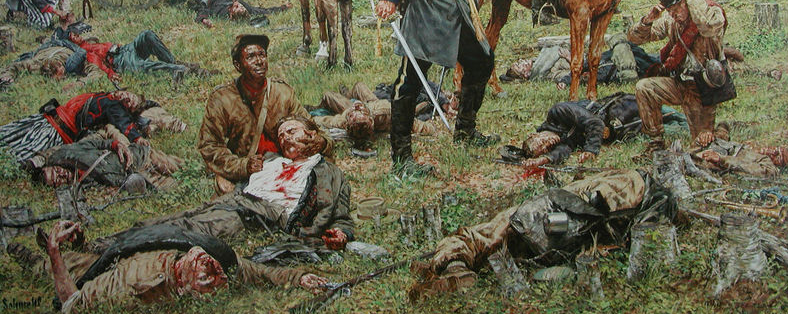
"Grim Harvest of War" by Bradley Schmehl
While modern day Lost Cause advocates of the black Confederate myth overwhelmingly refer to these men as soldiers, their preferred narrative falls right out of a late nineteenth-century fascination with the loyal camp or body servant. As I’ve said before there are almost no references to loyal black Confederate soldiers before the 1970s. What you will find, however, are scores of Confederate Veteran magazine accounts and other works of popular literature that wax poetic about the loyal body servant, who rushed to the battlefield to tend to his master’s wounds or to escort his body home in the event of his death.
I am doing my best in the first chapter of my black Confederate book to explore the complex exchange between master and slave that ensued as a result of being away from home and loved ones and in light of the many challenges associated with camp life and battle. The difficulty is compounded simply by the fact that we have so few black voices to work with. What I find so disturbing about this and other interpretations of that relationship is that it harkens back to blatantly racist notion that slaves could not live without their masters. The loss of the master was tantamount to the loss of a limb. To put it bluntly, it’s dehumanizing.
One wonders what was going through Bradley Schmehl’s mind when he painted “Grim Harvest of War”. Was he visualizing the stories of Thomas Nelson Page or those of Ann DeWitt?
The truth is that each of these relationships was and has to be seen as unique. Man has always proven to be despotic, so no glorification of slavery here. But to assume that all master-slave relationships were evil, harsh, or replete with bull whips and blood are far from the facts. Robt. E. Lee took leave from the Army to take care of the blacks at Arlington plantation, which his wife inherited. They were all of old age and what Lee basically inherited was an old folks home for slaves. When a formerly freed slave came back to Arlington to get his brother, Lee asked, “how will he survive?”
The former slave answered, “I’ll take care of him.”
Lee immediately freed him and they went off to Philadelphia free men`. I have no doubt that the blacks at Arlington fared much more poorly after it was occupied by Federal troops than when Lee owned it.
This is a microcosm of the complexity of the situation and it is not at all hard to believe that love could exist between a white and black man that grew up together regardless of their station or title. Boys become men, and men still have hearts. That’s why these blacks took the bodies home and cried with the rest of the families. Because a loved one had died.
Nathan Bedford Forrest had over thirty slaves of his fight with him the entire war and none deserted. They could have simply rode off to the North. They didn’t.
The painting shows grief. The fact that it is a black man crying over his loved one shows the heart and soul of the slave, servant, friend. A person can be all three. History proves this abundantly.
Doe the artist show any white men crying? Crying tends to be associated with children and women and a man crying might be seen as being less than a full adult male. The black man crying over his “beloved master’s grave” would then be reduced to the role of a child or other dependent.
Of course, if he’s not crying then never mind. I can’t tell from the low resolution section on the screen.
He is clearly very upset. 🙂
He’s clearly laughing.
Perhaps he is upset as he now contemplates his future. Since his master is dead, he will either be sent back to the plantation, likely along with his master’s other property and personal affects, or he will become the servant/slave of one of the other Confederate officers shown in the painting. As the battle is over, and he is still clearly within the Confederate lines, he is probably also mourning his missed opportunity to escape.
One thing is for sure, he will not be handed an Enfield rifle and a cartridge box and put into his Master’s old company, no matter how upset he gets.
Studying the painting closely, you can clearly see the “black confederate” is actually snapping the wounded man’s neck, just to make sure he’s dead.
Sometimes when untrained observers study a piece of evidence like this, they can be misled. Hope this was helpful.
I’m reading “Retreat from Gettysburg” by Kent Masterson Brown at the moment and there are a lot of stories of black servants helping watch over or take care of their wounded masters. There also the story of Isacc Avery’s slave taking Avery’s body all the way back to North Carolina to be buried after the battle. Why did that guy do that?
Schmel’s painting doesn’t come across as too inaccurate to me. The battle is over and it wasn’t like the soldiers’ servants were that far away from the action that they wouldn’t be running to find out what happened to their particular master. Brown writes of this happening at Gettysburg actually. I’m sure even some of them wore butternut and kepis. The Confederates apparently wore whatever they could find to wear. I’m sure their slaves did too. Although he appears to have painted Louisiana soldiers from Taylor’s brigade and apparently they were all fitted out in gray and had gaiters and what not (at least at the beginning of that campaign).
Then again, there are plenty of stories of servants taking the opportunity of battle, retreat, or whatever to run away from their enslavement. That could be painted as well.
I get that you want to obliterate the larger myths, but as far there having been “loyal” servants and all, history shows there were plenty of slaves, that for whatever reason, were steadfast towards their owners. So the whole loyal slave myth arguably derives from a set of truths. The larger myth may be inaccurate, but not the set of truths the myth derives from.
Lyle,
You make some excellent points. Brown’s book has proven to be incredibly helpful to me in this project. As for Avery’s slave transporting his body home, I was confronted with the same question with Silas Chandler. What I can say in the case of the latter is that I simply have no idea. Silas’s home was back in Mississippi and he had a family on the Chandler plantation. He could have escorted the body back for any number of reasons that are not mutually exclusive. I also don’t doubt that there may have been a certain bond between the two within the confines of the master-slave relationship. As I’ve said before, my problem with all of this is the ease with which people speak for those who were not able to speak for themselves.
I also pretty much agree with you re: the image I chose for this post. Like I said at the end of it I have no idea whether Schmel had Page or DeWitt in mind, but I suspect it was more of the latter. Thanks for the comment.
If I’m not mistaken Schmehl painted a black Confederate in the painting you posted yesterday. If so, that belies his intent with the painting. So I’d have to definitely agree with you that would be problematic.
And I’m definitely with you on speaking for people who were not able to speak themselves We don’t know why Avery’s slave did what he did, we just know he did it. So we just have to let that act speak for him, just as if he had run away from Avery at some point, if he had done that.
Hi Kevin,
Man, I had no idea that the painter was a contemporary until I clicked through to his site. When I introduce or briefly discuss the plantation tradition in American lit surveys or other similar courses, I usually do so principally by simply quoting the slave story-teller Sam’s line about the antebellum world of slavery (to that white, Northern traveler who is his audience) in Page’s “Marse Chan”: “Those were de good ole times, de bes’ Sam eber see.” (Paraphrase without the text at hand but I think it’s close at least.)
Doesn’t get much more concise than that, and it’s disheartening to me to see a modern painter replicating that story’s (and so many others’) images so fully.
Keep up the great work, and looking forward to your book (the upcoming one and this future one),
Ben
Nice to hear from you, Ben.
This tradition can be found in numerous places. To give my students a sense of its continued influence I have them analyze the Dixie Outfitters website. I looked for some commentary re: the scene, but came up with nothing.
A servant sent off to war with “his master” lived a very different life than a field hand did.
That there would be a bond, and even affection is not out of the realm of possibility.
But that story would represent a tiny percentage of the master/ slave relationships.
The dishonesty is when such bonds, are held up as the norm and not the rare exception.
One thing you’ll see if you dig into accounts of African Americans at Confederate reunions or getting written up in Confederate Veteran, it’s always a personal servant of some kind — a body servant, a cook, etc. Always. I’ve never yet seen an example of a slave laborer pressed into service to dig trenches or construct fortifications, gladly posing for pictures in a Confederate uniform at some reunion forty, fifty years later, even though they were far more numerous in the overall Confederate war effort. It’s that personal-but-never-equal relationship between the white veteran and the black servant that is the key to understanding this stuff.
Kevin’s correct — examples that are now being peddled as cases of white and black brothers-in-arms, standing together against a common foe in defense of the South, were seen by the white veterans themselves as examples of a different sort, praised for their personal loyalty before, during and after the conflict, content in their place and unswayed by the agitations of radical Republicans or others seeking to overturn the status quo ante.
What I find so interesting is the extent to which the distinction between impressed, free blacks, and body servants has been collapsed by modern day proponents of the BCM. They are all funneled through this narrow narrative of the loyal slave that the veterans and Americans at the turn of the twentieth century identified.
The confederate veteran should be required reading for anyone wanting to study this topic. Southern aristocrats talk alot about this subject in the CV but that does not translate over to southern monuments. I have only seen 2 out of 108 (1.85%) of monuments in North and South Carolina that express the sentiment of a loyal slave/servant. Rich man’s fantasy world.