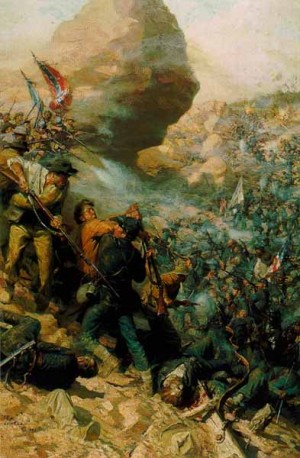
The Crater by Tom Lovell
I am almost finished reading Newt Gingrich’s co-authored historical fiction on the Crater
Even without having finished the book, what is clear is that Gingrich and Forstchen do everything they can not to offend, which is quite an achievement given the nature of the subject. Let me just give you one example. All of you have read that the Fourth Division went into the battle with the cry of “No Quarter.” That reference appears twice in the battle sequence, but take a look at how it is framed by the authors:
There was no quarter. The pent-up rage, the insanity of a world that had driven them to this moment, was unleashed, both sides screaming “No quarter, no prisoners! as they shot , cut, and slashed at each other. [p. 259]
Both sides were screaming foul oaths of hatred and rage. Centuries of slavery and the cruelty and fear it engendered, combined with three years of bitter war with no end in sight, unleashed a pent-up fury on this day as both sides screamed: No quarter, no prisoners!” [p. 266]
They certainly were, but we also know based on the historical record that the black troops screamed, “Remember Fort Pillow.” That, of course, is conveniently left out as is pretty much any reference to the racial hatred that animated Confederate troops during the battle. There is a context for understanding cries of “No quarter” that animated the black men in blue that is crucial to this history. They knew what was at stake if captured. The same holds true for Confederates who faced the attack of the black troops as well as those who heard about it. Their rage took a specific form that had its roots in white supremacy and fears associated with slave rebellions that extended back into the antebellum period. Unfortunately, it looks like this theme will continue to be ignored in what remains of the book. More later.
Speaking of US Colored Troops…The Organization of American Historians has awarded its 2012 Richard W. Leopold Prize to William A. Dobak for his newest book, “Freedom by the Sword: The U.S. Colored Troops, 1862-1867,” (Center of Military History, 2011). The Leopold Prize is given every two years for the best book on foreign policy, military affairs, or the historical activities of the federal government by a government historian.
Thanks, John. I definitely need to check this out as soon as I build up enough book credits through my Amazon site. Got to love the $69.95 price tag.
Nothing beats a solid, bound volume in one’s hands, but this one’s available as a PDF download.
Awesome. Thanks, Andy.
A shame. What can be learned from glossed-over accounts? Here is another firsthand view from the collection of letters that I just finished transcribing and publishing (No Freedom Shrieker; The Civil War letters of Union Soldier Charles Biddlecom):
“August 1, 1864. Yesterday afternoon we were marched from our old camp near the railroad that runs from Petersburg to Norfolk along the right of the line held by the Fifth Corps, joined Burnside’s left flank distant something less than one mile fromthe point in Burnside’s center where he mined the Rebel fort. After blowing it, two regiments of confederate infantry, and sixteen cannons skywards, Burnside made a charge with his darkies, or rather the nigs charged and took the debris of the fort and then made a dash for Johnny’s second line. They were repulsed and driven back to the ruins of the fort where they stood their ground for some two or three hours and were then charged out of it and into their own works,
losing very heavily. Darkey done well as long as the white officers stayed with
them, but their officers were either drunk, or else, d––d dumb. A good deal of
both, I guess. What officers did stay with their sable commands acted like
fools and would not let the Africans shoot at the Rebs. They even went so
far as to make the men take the caps off their guns and unfix their bayonets.
All this was caused, as we understand, by the Rebs coming down with their
arms reversed, making the officers think they were going to surrender. When
the Rebs got within short range, they turned their musket muzzles forward
and gave the blacks a withering volley and then charged with the bayonet. Of
course, the blacks run. There never was (were) men born that could stand such
a charge. “