I think Gary Gallagher makes a pretty good case for why black soldiers were not present at the Grand Review in Washington D.C. in May 1865. He argues that their absence had little to do with scheming politicians and military brass, who hoped to keep it an all-white affair. The parade was made up primarily of units that were in the process of being demobilized. Since black units were raised later in the war they remained stationed in various parts of the South.
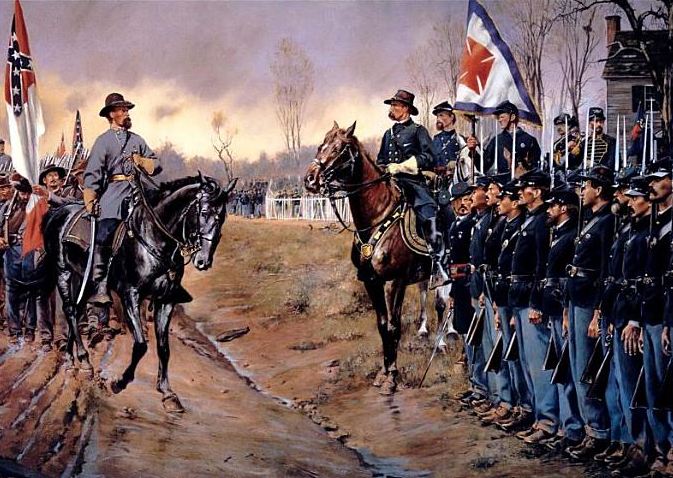
In contrast, black troops under Edward O.C. Ord’s command were at Appomattox Court House in April 1865. Anyone who has read William Marvel’s books on the march out of the Petersburg trenches and surrender knows that these units were kept in camp behind their white comrades once the Army of Northern Virginia surrendered. Before the surrender ceremony on April 12 these men were ordered away from Appomattox. Marvel suggests that this was done “for the sake of serenity.” That seems like a reasonable explanation.
One wonders how their presence might have shaped an account of a salute that may or may not have taken place.
Civil War Memory has moved to Substack! Don’t miss a single post. Subscribe below.
Well you all need to do your homework. In actuality the 135th United States Colored Troop march with General Sherman in the Grand Review/Parade on May 24, 1865. I have it documented as such in their regimental records.
Jay
London JohnApr 12, 2012 @ 5:03
According to Joshua Lawrence in The Passing of the Armies, written 50 years after the event, altho’ there were no Black troops in the Grand Review, Sherman’s army was accompanied by both liberated slave families (which makes a nice contrast with Roman triumphs featuring the newly-enslaved) and Black labourers attached to the army. Presumably the latter did the sort of work done by slaves for the Confederate armies, but no-one has ever claimed they were soldiers.
Chris ReinAug 28, 2017 @ 16:11
Actually, they were soldiers. The three pioneer companies of the 16th Army Corps (later transferred to the 4th Division, 15th Army Corps) had been mustered in as Companies A, B and C of the 110th USCI (2nd Alabama, African Descent) by Grenville Dodge at Pulaski, TN in November, 1863. (The order is in Dodge’s Papers at the State Historical Society of Iowa in Des Moines: Headquarters, Left Wing, 16th Army Corps, Special Orders No. 15, Nov. 18, 1863, Pulaski, Tenn., Copy in Box 58, File 137:2) They accompanied Sherman on the March to the Sea and through the Carolinas campaign. In record of events for the 110th USCI for the month of May, 1865, the regimental returns show “near Washington, DC.” (M594, Roll 216, page 165, https://archive.org/details/compiledrecordss0216unit)
Thus, the three pioneer companies of the 110th USCI were the black pioneer units Sherman, Chamberlain and others refer to in the Grand Review. They were mustered soldiers. They may not have had uniforms, as the unit records indicate they literally worked them to shreds, corduroying roads in the swamps of the Carolinas, and they might have chosen to march with their tools, because the soldiers surely knew who had built the roads they marched over, and the entrenchments they fought behind, and carrying their axes and shovels would serve as an identity badge. But they were mustered soldiers, just as engineer troops are soldiers today.
There surely should have been more USCT soldiers in the Grand Review, given their numbers and contribution to the war effort. Unfortunately, many, including the remaining seven companies of the 110th, were still on duty protecting railroads in the South or returning to their unit from captivity in Mobile, where they had been forced to work on the Confederate fortifications there. Full details are available in my forthcoming book ‘Alabamians in Blue.’ (LSU Press, 2018)
TF SmithApr 10, 2012 @ 20:00
Did USCTs particpate in any of the CSA surrenders? Johnson in the Carolinas, or Kirby Smith in the TransMississippi?


Well you all need to do your homework. In actuality the 135th United States Colored Troop march with General Sherman in the Grand Review/Parade on May 24, 1865. I have it documented as such in their regimental records.
Jay
According to Joshua Lawrence in The Passing of the Armies, written 50 years after the event, altho’ there were no Black troops in the Grand Review, Sherman’s army was accompanied by both liberated slave families (which makes a nice contrast with Roman triumphs featuring the newly-enslaved) and Black labourers attached to the army. Presumably the latter did the sort of work done by slaves for the Confederate armies, but no-one has ever claimed they were soldiers.
Actually, they were soldiers. The three pioneer companies of the 16th Army Corps (later transferred to the 4th Division, 15th Army Corps) had been mustered in as Companies A, B and C of the 110th USCI (2nd Alabama, African Descent) by Grenville Dodge at Pulaski, TN in November, 1863. (The order is in Dodge’s Papers at the State Historical Society of Iowa in Des Moines: Headquarters, Left Wing, 16th Army Corps, Special Orders No. 15, Nov. 18, 1863, Pulaski, Tenn., Copy in Box 58, File 137:2) They accompanied Sherman on the March to the Sea and through the Carolinas campaign. In record of events for the 110th USCI for the month of May, 1865, the regimental returns show “near Washington, DC.” (M594, Roll 216, page 165, https://archive.org/details/compiledrecordss0216unit)
Thus, the three pioneer companies of the 110th USCI were the black pioneer units Sherman, Chamberlain and others refer to in the Grand Review. They were mustered soldiers. They may not have had uniforms, as the unit records indicate they literally worked them to shreds, corduroying roads in the swamps of the Carolinas, and they might have chosen to march with their tools, because the soldiers surely knew who had built the roads they marched over, and the entrenchments they fought behind, and carrying their axes and shovels would serve as an identity badge. But they were mustered soldiers, just as engineer troops are soldiers today.
There surely should have been more USCT soldiers in the Grand Review, given their numbers and contribution to the war effort. Unfortunately, many, including the remaining seven companies of the 110th, were still on duty protecting railroads in the South or returning to their unit from captivity in Mobile, where they had been forced to work on the Confederate fortifications there. Full details are available in my forthcoming book ‘Alabamians in Blue.’ (LSU Press, 2018)
Did USCTs particpate in any of the CSA surrenders? Johnson in the Carolinas, or Kirby Smith in the TransMississippi?
Just wondering, actually.