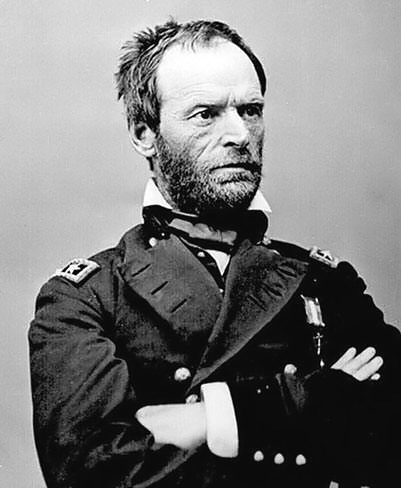
 In addition to giving a talk on how to teach Civil War monuments in Charleston for the Civil War Trust, I also took part in a panel discussion in which participants could ask anything that was on their mind. Some of the participants submitted their questions beforehand. One participant asked what war crimes William Tecumseh Sherman could be brought up on for his actions in Georgia in 1864. Well, I jumped all over that one.
I recommended that if the individual in question is sincerely interested in the relevant history of Sherman’s March and how it fits into broader United States military policy during the Civil War that he/she ought to read Mark Grimsley’s The Hard Hand of War. I pointed out that Sherman did nothing that would warrant anything along the lines of a war crimes trial and that if we were to do so posthumously we would have to apply it to scores of American commanders throughout the twentieth and twenty-first centuries along with their civilian authorities.
While I wasn’t sure that it applied to this particular individual, I went on to suggest that people who pose these types of questions are motivated by some irrational belief that they themselves are victims of Sherman’s army. They maintain a close identification with those people who were impacted regardless of whether their ancestors lived in the army’s path.
I suggested that this type of identification has very little to do with history and everything to do with an emotional need of the individual. I certainly don’t believe that I or anyone else for that matter has a responsibility to acknowledge such a question as anything more than this. In short, it doesn’t deserve to be taken seriously beyond its significance as one of the last vestiges of the Lost Cause.
It’s one thing to imagine those involved and perhaps the next generation maintaining a less than gracious attitude toward Sherman, but as far as I am concerned such a stance carries no weight today. [On this point, see Thom Bassett’s recent article in the Civil War Monitor on Sherman. He argues that Sherman’s reputation remained fairly positive during the first few decades after the war.]
Regardless of where you live and how you happen to trace your family lineage, no one today is a victim of Sherman and his army. We would do well to find demons that did something other than help to preserve this nation during war.
Using the reasoning that no Southern person alive today was NOT a victim of Sherman’s March; then no black today was a victim of slavery.
Exactly. Reparations are illogical and dangerous. My Great Grandfather was a slave whom fought with the Union and was used for cannon fodder. He was a great family man and I am most proud of his legacy albeit cut short by the illness of the war. Lincoln was a war monger and war criminal. Even Pulitzer historians are retracting previous contention. This Levin guy is a carpet carpetbagging transplanted
“professor “ dedicated to poison the facts that are coming out like a rapid stream well documented facts of Lincoln’s fraud in his election and his starting the war . Levin’s fraud particularly when it comes to Black Confederates where he has been debunked with empirical evidence by real academic scholars Louis Henry Gates and Harvard’s Stoddard. He won’t acknowledge the real cause of Lincoln’s railroad corruption nor the evidence of the war was over the financial “ duties” which came from Lincoln’s own mouth.
This contention was put in the ground when the south lost the war. That anyone would conflate the loss of a war, one that the south started at that, with slavery is gobbsmackingly stupid.
The south just continues to hurt itself in confusion.
“I pointed out that Sherman did nothing that would warrant anything along the lines of a war crimes trial.”
Mr. Levin seems to have little or no legal background, as any third year law school student will tell you that Sherman’s actions are textbook examples of war crimes of the time.
How then can you take “scholars” like this seriously.
Richard Lee – lawyer.
Fascinating legal analysis. 🙂
Courtrooms use factual evidence. Any third year law student that says Sherman’s actions are textbook examples of war crimes at that time should turn in their books and start flipping burgers. The factual evidence shows that they were not war crimes.
Saying you are a lawyer proves nothing. All you have done is deliver your opinion and it comes up short.
I abhor Sherman. I believe he his express aim was making war against the Civilian population of the Confederacy which although effective was still targeting non-combatants.
My question for the Next Civil War:
Is targeting civilians okay? Sherman would argue that we might indiscriminately seek to kill and starve cities to achieve our political goals. Do you really feel this is acceptable for population centers to be targeted by fellow Americans?
Perhaps you ought to spend some time with the 20th century. Every major military conflict included civilians as targets to one extent or another. What is your view of atomic bombs dropped on Japan?
Was it acceptable for Americans to own other Americans?
I believe his express aim was making war against the Civilian population of the Confederacy
Matt, this may be your belief, but it is incorrect. The idea that Sherman targeted civilians in Georgia and the Carolinas the way that the WW2 Allies targeted civilians in Dresden and Hiroshima is not historically accurate. There is plenty of recent scholarship which demolishes the Lost Cause myths about Sherman’s rapaciousness which you might find interesting if you are open to revising your beliefs.
You have a valid point here – no one can deny that nationalist, irredentist, nostalgic fantasies of loss, injury and insult at a national and ethnic level have fuelled regional and national conflicts and justified myriads of acts of terrorism. The belief in such fantasies may be found in many regions, countries, races and ethnicities. To repudiate or deconstruct such fantasies would perhaps assist in deconstructing a lot of violently defended polarities in global flashpoints. With the downing of a civilian jet in the Ukraine, we can see how imagined narratives of nationhood and territory have realtime flow on. However if you suggest that folk memories of Sherman’s march could be effectively publicly debated and diminished, then a similar process should be applied to parallel myths of victimhood that serve as a cultural identifying myth such as those found in the Balkans, the Middle East, Africa, Eastern Europe – if one accepts that no living person of 2014 was physically or mentally injured by a soldier under the command of Sherman, then how can one then say that seeing a battleflag on the Washington and Lee campus makes a prosperous, highly educated person feel that they are wearing the shackles of a system of chattel slavery that again ended a century and a half ago as did Sherman’s march – to say that some people are more susceptible to memories of inherited trauma seems to refer back to old “hierarchies of races” parascience – which all educated people reject – or should we allow people to access and reference their culturally inherited beliefs on an equal basis?
With due respect, Mr. Levin, you need to read true history and not the “politically correct” trash far too active on our present American scene. Being a descendant of several Confederate fighting men, not to mention my own father who was a “real son,” meaning he personally knew his grandfather who served in the Southern ranks, I must inform you that WT Sherman was a vicious, cynical, self-glory-seeking lunatic who, if the United States authorities at that time had any shred of decency, they would have had him arrested, tried by a military tribunal, found him guilty of crimes against innocent, defenseless civilians, and hanged as a war criminal. But is not that the way it often is, that the military victor always seems to come out clean and justified in his actions? Still, and I confess i feel an air of satisfaction, that such persons as Sherman as well as Hitler, Stalin, and yes, Saddam Hussein, if they refuse to trust in the grace and mercy of Christ before they die, there will be perfect Justice done from the Great White Throne. Take some time, if you will, to study over the photos of this hero of yours, and tell me you see the face of a man who knew anything about compassion and mercy. I have spoken my peace. Take it anyway you wish. I mean you no offense, but only to try to help you face reality as opposed to succumbing to naive presuppositions.
Thanks for the advice.
Many are going to already be aware of this. Indeed, it may have been posted earlier! But a good read in any case, as Mark Grimsley writes about the Hard Hand of War and Uncle Billy’s March to the Sea:
http://people.cohums.ohio-state.edu/grimsley1/dialogue/long_shadow.htm
A friend of mine told me about visiting a town in Georgia where he was emphatically told that the evil Sherman had burned every single building in town. Without missing a beat, his host then proceeded to show him the town’s beautiful antebellum architecture.
Are we victims today, maybe not but are we still affected by it – YES. Just ask anyone who is has tried to research their family history or land holdings in anyone of the southern states that were targeted by Sherman. One has to ask why did the war start and why did it end. The real battle was between state vs federal rights and the independent economies of the south and the desire of the north to become involved in it. Why did the war end, the north was successful in destroying the financial stability of the south and no longer were kept out of their finances.
Then the same would be true for Jews who were personally not imprisoned and tortured by the Nazis and the American Indian today whose ancestors endured the Trail of Tears and African Americans whose ancestors were slaves? What a double standard is applied by most people.
Question: what was the last Confederate city/town to be torched? And who ordered the burning?
Answer: Richmond and Robert E. Lee.
If anyone was a Civil War War Criminal, surely Lee, ordering the destruction of Richmond as he abandoned it, with the end of the war near, fits that definition.
When ever someone complains about alleged Yankee war crimes, I always ask them about 20th Century Yankee bombing of Europe and Japan. Was my uncle, who piloted B-24s over Italy, bombing, a war criminal?
In another context, the title of your post could refer to that strange 1980s documentary about the guy who travels through the South meeting women, or that low-budget History Channel production from a few years ago. Anyone who has seen those is indeed a victim of “Sherman’s March.”
I’m reminded of Machiavelli’s line, “But when it is necessary for him to proceed against the life of someone, he must do it on proper justification and for manifest cause, but above all things he must keep his hands off the property of others, because men more quickly forget the death of their father than the loss of their patrimony.”
Jonathan, very appropriate. My grandfather, born in 1900, still remembers his grandmother talking about the soldiers singing ‘Battle Hymn of the Republic’ as they burned down her father’s home. In this case, the burned house was a very real and traumatic civil war memory. He could take you to the ruins and point to the foundations and relive her story. That’s a very powerful thing to a young mind. To Southrons, hatred of Sherman is taught as a catechism. While I am not a victim of Sherman, I can say I’ve certainly have been impacted by him. Heck, the folks in those part of the woods still talked about Tarlteton with an air of disdain.
Christian McWhirter, in his new book on Civil War music titled “Battle Hymns,” asserts that Julia Ward Howe’s “Battle-Hymn of the Republic” was actually seldom played or sung during the war, and very seldom by soldiers; it only became an iconic hit in the decades after the war. It’s hard to imagine Sherman’s boys belting out the song’s complicated lyrics as they torched someone’s home. Perhaps they sang the more popular “John Brown’s Body.”
I’m not calling your relative a liar; maybe it really happened as he described. But we’ve seen how the reality of what Sherman and his men did frequently became distorted in the bitter postwar atmosphere and subsequent nostalgia for the Lost Cause.
Will is likely correct (and thanks for the plug). Sherman’s men probably sang “John Brown’s Body” instead of “Battle Hymn of the Republic.” The latter is often projected back onto the historical record because people see the “Glory, glory Hallelujah” chorus and assume it was Howe’s lyrics but I found it was almost always “John Brown’s Body.” Indeed, the song was a particular favorite of Sherman’s men during the March.
Sherman’s military policy against Southern civilians was so successful that he used it out west against Native Americans…except he kicked it up a notch or three. He complained to the N.Y. times shortly before his death that if not for do gooder civilians his army would have “gotten rid of them all” and killed every last Indian in the U.S. (Marszalek, p. 400 A Soldiers Passion for Order). As London John ponders about lost causers; can it also be said, “Do many Americans take the attitude to Native Americans ‘You lost: get over it’?
In my opinion Native Americans today have a legitimate beef against Sherman and other white aggressors of the 19th century because it can be demonstrated that the subpar economic prospects and quality of life in their communities stem directly from their treatment at the hands of whites in the past. White Southerners cannot convincingly make such an argument.
Do modern Confederate apologists ever speculate on the “war crimes” committed by Wheeler’s rebel cavalry on their fellow Southerners during Sherman’s march?
I think you’re quite right that the same individual can be a hero in one situation, such as Sherman or Sheridan in the Civil War, and a villain or war criminal in another, such as Sherman or Sheridan in the Indian Wars. Here in Britain, I maintain that Churchill was a hero with regard to Nazi Germany and a villain wrt India.
I don’t think you can equate the Native Americans with the Confederates, nor attitudes in the Union army during the Civil War towards the enemy with the racist attitude towards the Native Americans during the Indian Wars.
It is to bad we didn’t have Sherman available earlier in Alabama=Mississippi-Georgia in the War of 1812/Creek Indian Wars. Then he and Gen. Jackson could have just finished off all of the “merciless Indian savages” in place. No “trail of tears” and all that nonsense, then Oklahoma would be O.K.
Is the question framed in the context of the law of war and humanitarian law in 1861 or in terms of modern international law?
I don’t believe that most people who ask this question are even thinking about any kind of legal context. The question is more a knee-jerk reaction.
What of those that bring up arguments dealing with the Lieber Code?
You hear it every so often, but how did Sherman violate the Lieber Code?
Items 143 and 144 dealing with Atlanta.
143. When an armistice is concluded between a fortified place and the army besieging it, it is agreed by all the authorities on this subject that the besieger must cease all extension, perfection, or advance of his attacking works as much so as from attacks by main force.
But as there is a difference of opinion among martial jurists whether the besieged have a right to repair breaches or to erect new works of defense within the place during an armistice, this point should be determined by express agreement between the parties.
144. So soon as a capitulation is signed the capitulator has no right to demolish, destroy, or injure the works, arms, stores, or ammunition in his possession, during the time which elapses between the signing and the execution of the capitulation, unless otherwise stipulated in the same.
How does this apply to Sherman? I always thought he was at war against the Confederate government in Richmond, Virginia. Let me say that I claim no authority here as a legal scholar and this thread is already moving from the crux of the post, which is fine.
Well, items 143 and 144 (above) of General Order 100 dealt with the siege and surrender of fortified places. In Sherman’s case Atlanta was surrendered to the US 20th Army Corps. Sherman’s actions afterward, conflict with these two items of the order. He sent civilians out of the city into the country side and set fire to the city.
Again, I am not an expert, but can’t you interpret Lieber as supporting Sherman’s broad military policy in Georgia?
Military necessity allows of all destruction of property, and obstruction of the ways and channels of traffic, travel, or communication, and of all withholding of sustenance or means of life from the enemy; [and] of the appropriation of whatever an enemy’s country affords necessary for the subsistence and safety of the army.
Precisely. Item 145 states:
. When an armistice is clearly broken by one of the parties the other party is released from all obligation to observe it.
The code never actually defines what breaks an armistice, or who can break it for that matter. There seems to be plenty of loopholes open for exploitation. Of course, I’ve read before the argument where Sherman felt that his March was the fulfillment of that code.
There was no “armistice” in the sense of the Lieber Code. Atlanta was abandoned by the CS forces (who actually caused most of the damage by blowing up ammo trains). There is another clause in the Code which specifically allows destruction of public facilities in a captured city, I believe.
The Lieber Code is not very helpful and as I suggested already most people who ask these types of questions are not really talking about history.
If an historian was going to investigate Sherman’s command responsibility for the actions of his troops I would think the Lieber Code (which would be the applicable legal standard he was operating under) would have to be at least a starting point. To put it another way, if you don’t use the context of the Lieber Code then what would your basis for making an evaluation be?
Removing the most objective context for reviewing the historical facts in this instance would seem to presuppose the question can’t be raised. Especially if the interlocutor presumes to know the motivations of the person raising the question, their emotional needs, and even their geographic background.
I would point out Sherman’s actions with regard to command authority have been the subject of numerous papers by historians, legal experts, and on occasion international lawyers. None of whom, I am guessing, pursued their studies from some deep seeded emotion need to identify with the South.
Personally, I don’t see such questions as out of bounds. As with any question involving speech and opinion, I think more is better.
If an historian was going to investigate Sherman’s command responsibility for the actions of his troops I would think the Lieber Code (which would be the applicable legal standard he was operating under) would have to be at least a starting point.
No disagreement whatsoever.
Personally, I don’t see such questions as out of bounds. As with any question involving speech and opinion, I think more is better.
Again, no disagreement. As I said, I don’t know the motivation of the questioner and I prefaced my response with it as well. I initially addressed the question with a brief historical analysis based on Grimsley’s book. In my experience, however, an objective analysis is usually not what is wanted.
James,
Mayor James Calhoun, and a committee of Union-leaning citizens met a captain on the staff of Maj. Gen. Henry W. Slocum and surrendered the city, asking for “protection to non-combatants and private property” (Garrett book below)
38. Private property, unless forfeited by crimes or by offenses of the owner, can be seized only by way of military necessity, for the support or other benefit of the Army or of the United States.
If the owner has not fled, the commanding officer will cause receipts to be given, which may serve the spoliated owner to obtain indemnity.
I believe that is the section you are referring to. Sherman uses the military necessity argument in his memoirs. His precedent will actually give officers of the Philippine-American War grounds for argument in defense of their actions. From what I gather from military historians, is that Sherman violated the Lieber Code in his initial bombardment of Atlanta without announcement.
As far as who burned what,
On the final night of the Union occupation, November 15-16, Union troops, encouraged by the arson carried out by the engineers, committed unlicensed burnings that set much of downtown afire. Viewing from headquarters the fiery glow over much of the city that night, Major Henry Hitchcock of Sherman’s staff predicted, “Gen. S. will hereafter be charged with indiscriminate burning.” The Union army left Atlanta the next morning.
http://www.georgiaencyclopedia.org/nge/ArticlePrintable.jsp?id=h-2713
Just to clarify. I’m not in any way a “Lost Causer.” Being from Georgia I find those people incredibly annoying. I just really like debate and working out intricate points such as this.
Garrett, Franklin (1987). Atlanta and Environs: A Chronicle of Its People and Events, Volume 1. University of Georgia Press.
Yeah, I hear this one all the time. Supposedly my family in VA and NC were victims, even though he only got part of NC and none of VA at all. LOL.
I am not sure where your family is but I have lived in SW and Central VA all of my life and never once heard anyone mention Sherman or that his actions impacted this area.
I used to live in a community where nice folks told me again and again how that terrible Sherman had burned down the town. Generally it made it worse to tell them that he never set foot there. No one had heard of John Croxton, who actually did torch a quarter of the square. Sherman may have been a ‘war criminal,’ but town pride demanded his prescence.
Croxton and his failed raid into Carrollton Ga, I presume?
Tallapoosa Rangers drove him and the bluebellies out. I haven’t met any of those locals who claim Sherman was there like you say…
There were quite a few twenty years ago. I remember one civic group in particular where folks were so surprised that they invited me back a year later to talk about Sherman in depth. I’m not sure a few believed me even then but they gave me a really nice umbrella for my trouble and we parted friends.
I doubt it’s identification with one’s ancestors as much as it is identification with a couple of characters in a famous movie.
Most Lost Causers views of the CW have more to do with GWTW than with anything actually pertaining to history.
And I should point out that I have no idea as to where the questioner resides. I would not be surprised at all if he/she was from somewhere other than a former Confederate state.
I agree wholeheartedly that this smacks of the Lost Cause, and I’m sick of hearing these arguments, even among those who have no ties to the area in question.
What I’ve always found fascinating about the historical memory of Sherman’s march is how actions and destruction ascribed to his orders and his men actually took place after the war due to various reasons. David de Laubenfels published two articles in 1957 that dealt with the aftermath of the march to the sea and the actual landscape which offer an interesting insight to the question. Essentially he found that the majority of loss occurred in the post-war era as the result of farm reorganization and loss in the face of economic hardship after losing the war. My favorite aspect of his work points to the mythologies of destroyed homes. In one particular stretch of the march that he studied intimately, I believe only one or two of the homes that local lore declared were destroyed by Sherman’s men were actually destroyed during the march. The vast majority were lost due to fire or accident in the decades that followed.
By the way, what was the response to your answer?
Do people in Chambersburg get this hot and bothered about Jubal Early?
I don’t know, but bringing up Chambersburg is an excellent point. It was a hard war. For both sides.
IMO Sherman is one of history’s heroes. Not only did he save the Union, but his march directly liberated the slaves in its path. One of the most inspiring military campaigns known.
This White Southern self-pity about the ACW rather puts me in mind of Germans whining about the Allied bombing they brought on themselves in WWII.
Do many Americans take the attitude to lost causers “You lost: get over it”?
IMO Sherman is one of history’s heroes. Not only did he save the Union, but his march directly liberated the slaves in its path.
But not because Sherman himself had some great love for blacks.
True. http://www.georgiaencyclopedia.org/nge/Article.jsp?id=h-1086
Sorry, didn’t mean to put that hyperlink there.
Regardless of where you live and how you happen to trace your family lineage, no one today is a victim of Sherman and his army.
Interesting argument Kevin. How would keep this argument against one of the descendants of the Roswell Mill Workers? According to a few sources, there is little evidence that more than a few of these women ever returned home. I’ve seen a couple of arguments that descendants of the mill workers are victims of that deportation.
http://www.georgiaencyclopedia.org/nge/Article.jsp?id=h-1086
I am certainly not arguing that we cannot see the long-term consequences of past events. Rather, I am simply pointing out that no one alive today was targeted by Sherman, though some continue to behave as such.
Excellent clarification. Thank you.
I have sat in an SCV camp meeting and heard the recording of an actual victim of the other group of kidnapped victims of Sherman. She was 9 when forcibly removed from New Manchester Mills in Douglas County Ga with her mother and shipped to and dropped off in Ohio and left to fend for themselves.
She was an old woman when the technology was available to have her record her voice (wax tube on a hand cranked device) and told her tale. Her Ggrandson has the recording now on CD and he plays it for various groups from time to time.
I am surprised (NOT) to see your commentary on the fellow’s question, seeing how slavery reperations talk and slavery apologies have been in vogue the last few years. It is almost like some black folks feel they were slaves and have been wronged by CSA and USA policies like it happened yesterday instead of 150 years ago…
I totally agree Billy, Mr. Levin’s post immediately made me think of the demands for apology that are made regarding slavery. Apologies that would have to come from people who had absolutely nothing to do with it and are not supporting it today. Different issue of course but same principle.
Those, as well as the Sherman question mentioned above, come from an emotional place not one of reason, in my opinion.
No, it is not the same principle at all. Asking your government to acknowledge its role in history is a legitimate demand made by its citizens. It did so in the case of the internment of Japanese-American citizens during WWII, which seems to me to be justified and even helpful in coming to terms with certain aspects of our past.
The U.S. Government acknowledged its role when it passed legislation apologizing for slavery. There is also a dramatic difference between the Japanese-American citizens that received compensation. The surviving detainees were the main body that received payment, not descendants of several generations removed. Should reparations been paid? Of course. They did not however take place at that time and trying to implement payment today, beyond apology, would be counterproductive.
Or alternately. . .
This is fun!
Does that mean that the victims of Lawrance,KS,Quantrill?Or the Satlville Massacre?Or the Caduz,KY Massacre?Or the Shelton-Laural Massacre?Confederate Soldiers did laugh at Shelton Laural as they shot a 13yo boy who “squilled like a pig” and who also “begged for his life before being shot?”So when is the SCV gonnas pay reperations for those war crimes?
Bully for you. Bout time someone sets the record straight
In 1870, during the Franco-Prussian War, Gen. General von Blumenthal, in charge of the siege of Paris, turned down suggestions from from von Bismarck and others that Paris be shelled. Gen. General von Blumenthal backed by King Wilhelm I, thought it would be “immoral” to bombard” a civilian population center like Paris.
I would contend that warfare was becoming more “civilized” until Sherman was unleashed on the South (and he is one of many). The sack of Athens, Alabama earned the former Cossack commander, Col. John Turchin ( Ivan Turchaninov ) a promotion to general rather than the court martial’s judgment of expulsion (commanded by James Garfield).
This is why there is bitterness to this day in the South. It is not “The Lost Cause” it is the unacknowledged university burnings, church looting’s, rapes, and wholesale destruction of what was supposedly the North’s “brother’s property”.
When can debate whether the Lieber Code applied or not, but Lieber certainly thought it did as it was written to deal with the Union soldiers’ abuses in the South.
As to Sherman, his psychotic character is also shown by his statements and genocidal wars against the American Indians after the Civil War.
Am I a victim? No, not like everyone in the county claims they are as I was born 55 years ago. But my relatives were. But they survived and thrived which is the best payback
I’m sure you believe this. I see this technique among Lost Causers all the time: “But look what the Yankees did to the Indians!” Apples and oranges; two different histories.
In retrospect, Sherman’s March was mild compared to what could have been: true wholesale rape and slaughter. The Confederacy could have surrendered at any time–the war was clearly lost by winter of ’64–but their irrational racist ideology compelled them to fight far beyond what was reasonable.
They got off lucky.
Wow, you obviously have little idea of what you are talking. “irrational racist ideology”, “The Confederacy could have surrendered”… These are truly irrational statements with no bearing on ‘war crimes’ then or now. The actions that took place in Sherman’s arch were not acceptable at the time even as they are not acceptable today. In my studies as a US Army officer I can only say that the crimes committed were certainly heinous and should have resulted in war crimes charges even if the opposing side was a foreign enemy, not to mention civilians of a portion of the USA that the federal government was fighting to retain in the union.
With all due respect, let’s hope that somewhere in your “studies” you actually presented an argument to defend the claim that Sherman’s actions were “not acceptable at the time even as they are not accepted today.”
Especially since the Napoleonic Wars internationally destroyed our concept of “limited war,” something America didn’t realize until much later.
“Let’s quit pussyfooting and call it what it is. It’s murder, it’s slaughter, it’s clubbing baby harp seals.”
Lt. Col. Bryan P. McCoy, USMC, outside Kut, Iraq, April, 2003; quoted in Time magazine, April 14, 2003, p. 63
My uncle flew 25 missions as a B-17 pilot in World War II. I am sure he would be delighted to learn that his bombing of various cities in Europe were not “acceptable.”
my Dad flew with Bomber Command on Lancasters and Wellingtons and he segued between being depressed and deeply ashamed and guilty about what he did and saying that it was a necessity because he still did not trust the Germans – he was unusual – most of the other old airmen I met never had any regrets and could not understand why my Dad fluctuated. it also gave him the habit of solving a problem by destroying it in figurative or literal terms rather than thinking laterally