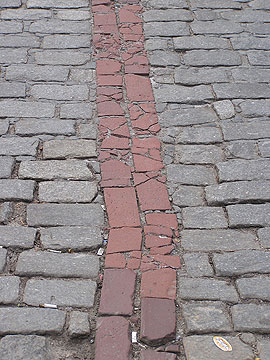
 I moved to Boston in July 2011 and I’ve loved every minute of it. It’s a beautiful city and for a history buff it really does feel like I am a kid in a candy store. That said, I’ve lived two lives since arriving here and I am now wondering if it is time to give in and embrace this thing called the American Revolution. Over the past year I’ve halfheartedly explored a few potential Civil War research projects that are centered here in Boston. They include a regimental history of the 55th Massachusetts Volunteer Infantry and a Civil War biography of Governor John Andrew. Both are projects that would, no doubt, be interesting to explore and I have no doubt they would be embraced by both scholarly and popular audiences.
The problem is that beyond a few trips to the archives I can’t seem to maintain my excitement level. I walk to the archives or wander through the city and I am distracted by a very different history. Downtown Boston is defined by the sights/sites and sounds of the American Revolution. There is no escaping this and since I have always viewed history as a way to connect to my surroundings I want to know more. This includes not only the physical landscape, but the community of people who are involved in its interpretation and maintenance.
Luckily, I am not approaching this history unarmed. While a graduate student in philosophy at the University of Maryland I wrote my M.A. thesis in philosophy of history. I focused specifically on what it means for two historical interpretations of the same event to be conflicting as opposed to conciliatory. My case study was the historiography of the American Revolution. During the research phase I took a graduate-level seminar on the Revolution with Ronald Hoffman. We pretty much covered the major schools of interpretation and since then I’ve managed to stay on top of more recent studies.
So, what to write about? Most of you won’t be surprised by this, but what I am most interested in are the bricks that make up Boston’s Freedom Trail. Begun in the 1950s, the Freedom Trail frames Boston’s Revolutionary history in a profound way. The path steers thousands of visitors each year through the winding streets determining what they see and hear. There is no one organization responsible for the trail and because it is physically laid out the trail is contested space. As a result, there are ongoing disputes about what sites and stories ought to be included.
Such a topic would give me the opportunity to explore issues related to tourism, public history, and historical memory and all in my own backyard. I haven’t thought much about the scope of the project, but I would want to write something that blends a scholarly narrative with the playfulness of Tony Horowitz’s Confederates in the Attic. I’ve only just begun to do some background reading on the subject so whether I carry through or not has yet to be determined. What do you think?
Kevin, when I took that exact path a couple years ago I found myself reinvigorated. I believe that you will too. This feeling was inevitable as you’re now living in the ‘Gettysburg’ of Revolution-era history. You have obviously embraced it, now take advantage of it. It is too bad that Patriots of the American Revolution magazine went under as it was a great platform for Eric and I to launch that new aspect of our work. However, I am sure that you will find plenty of opportunities to publish as it is a far too neglected subject when compared to other eras of American military history and is crying out for fresh perspectives and material. Welcome aboard. We are glad to have you!
Greetings from long island which tonight looks as it did in the 19th century
The freedom trail does not just tell you what sites to see it also it tells you how to get from place to place it even picks out which side of the street to walk on.
Hope you and your family are all safe tonight.
Good point. And don’t tell me local businesses didn’t campaign for that trail to go right in front of their entrances. 🙂
I’m friends (his son and my younger son were in school together) with Nat Sheidley, a former Wellesley history prof who’s now director of Public History at the Bostonian Society. He has a podcast as part of this Freedom Trail series:
http://www.thefreedomtrail.org/educational-resources/ftf-podcasts.shtml
and would be a great resource for this project moving forward, I’d say. Just saying.
Hi Ben,
I was hoping I would start to get just these kinds of tips. Thanks.
If you’re interested in Revolutionary War memory there are some fascinating items. Important thing to remember is that the Revolutionary past was filtered through the 19th and 20th century immigrant experience. The “yankee”(wasps) perserving “their” culture in the face of the flow of Irish, Italian and Eastern European Jews.
Absolutely. There is a very interesting example of this dynamic in Boston’s North End, where the Old North Church is located.
I would make sure to examine how America’s evolving relationship with the British influenced Revolutionary War historiography, especially during the World Wars. For instance Evacuation Day, the celebration of the 1783 British evacuation of New York, was a major holiday in New York City up until the Great War. Our even greater involvement with Britain during Second World War further influenced our perceptions of the American Revolution. Esther Forbes published Johnny Tremain, her wildly popular, Newbery Award winning novel about the Revolutionary War era, in 1943; at the same time American, British, and other forces were training in England for the D-Day invasion. The Disney film adaptation came out in 1957. Certainly these and other events influenced how the Freedom Trail was laid out just a decade later in the 1950s. There’s a lot to work with here.
That’s really interesting, Keith. Thanks for sharing. I need to pick up Michael Kammen’s book on historical memory and the American Revolution. It’s going to be an adventure if I choose to follow through with this.
One place i visit often is the major andre hanging site in old Tappan. You should look up the inscription which not only praises andre but says that the brits and americans are one race. Rewriting history to obscure a century of anglphobia was necessary to create the myth of the spe ial relationship
Clearly the hidden agenda here is that the gift that keeps on giving will have nothing more to give you. Perhaps there’s an American Loyalist Heritage Preservation Group just waiting in the wings.
What will they do? 🙂
Actually it’s more along the lines of Jefferson Could Do No Wrong mingled with themes of the Founding Fathers being diehard conservatives who would definitely be hard core right wing Tea Party Libertarian Republican Evangelical Christians today or whatever year it happens to be convenient for that element.
Want to piss them off? Just say Jefferson was the father of Sally Hemings’s kids. They start foaming at the mouth. Throw in a statement saying Jefferson was a liberal. It’s like stepping on an anthill.
Do it, Kevin! This is a book that’s just begging to be written. And let me know when it’s out, so I can put it on my public history syllabus!
Thanks for the words of encouragement, Jill. 🙂
It seems to me that would be a natural progression (even if it is chronologically backward) from your book on The Crater. With today’s political climate, the questions surrounding the meaning of the Revolution, and how it is remembered, are especially relevant. I think it would be a major contribution to not only the literature but to the public discussion as well. Go for it!
Best
Rob
I also agree that if I follow through it will be a natural progression.
The questions of memory that have been at the center of your scholarship on the Civil War are absolutely critical to grappling with the American Revolution. As you know, I took the plunge into this period of history after a longstanding interest in the Civil War and find it a rich place for new scholarship. You might have an interesting conversation with Jill Lepore on the intersection of memory and the Revolution. I also highly recommend Forgotten Patriots by Edwin Burrows, which explores the fate of POWs during the war and how they were remembered (or not) afterward. And then there is the whole story of class, race and ethnicity in the Continental army during the war. We really should find a free weekend this winter to get together!
Thanks for the book references. I enjoyed Lepore’s recent book on the Tea Party. I’ll be around and would love to meet.
Kevin,
Having grown up in the Philadelphia suburbs, I’ve long harbored a fascination with the Revolutionary War. I’ve explored most of the pertinent sites in Philly and in Boston, and some of the southern campaigns as well, and in its own way, I am just as intrigued by the Rev War as I am with the Civil War. I manage to split my time between them. There’s no reason why you can’t do the same. And, there’s still plenty of room for good scholarship in the Revolutionary War arena, and you do good work. I would encourage you to take the plunge.
Be prepared, though–there is much less good primary source material available and what there is can be more difficult to access. Still, it’s worth the effort.
Eric
Thanks, Eric.
At this point I am not too concerned about source material. Much of this will be built on archival material from the 19th and 20th centuries and hopefully a large number of interviews and personal experiences.
Follow the Red Brick Road, Kevin!!