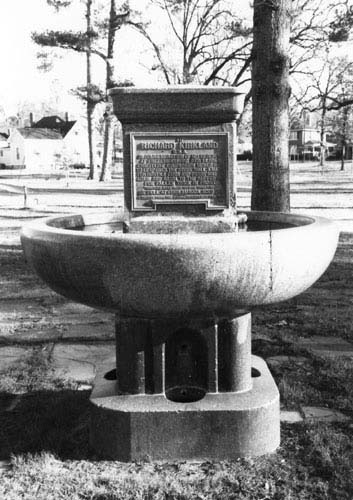
 I‘ve been thinking quite a bit about Sgt. Richard Kirkland lately. Last week Peter Carmichael referenced Kirkland in his speech marking the anniversary of the battle of Fredericksburg. Carmichael used the Kirkland story and his monument on the Fredericksburg battlefield to point out our tendency to glamorize the Civil War and ignore the more horrific aspects of battle and the challenges of soldiering. In addition, a new movie about Kirkland is scheduled to be released at some point soon. As someone who focuses on why we remember certain aspects of the war I am less interested in the history of Kirkland than in why his story continues to be so attractive. Actually, with all that has been written about Kirkland I am struck by how little we know about him. If you read the many short stories published about Kirkland at the turn of the twentieth century you get the sense that they are much more reflective of what the authors and society chose needed to remember about the Civil War as opposed to simply Kirkland himself. Kirkland serves more as a template for our collective memory of the war; one could almost say that we are using him for our own purposes. I think Carmichael is right about our selective memory regarding Kirkland’s actions. We want to see him as the “angel” in waiting rather than as someone who took part in the brutal slaughter of Union soldiers on that December day. The scores of published accounts and paintings narrow our focus of Kirkland’s experience at Fredericksburg to that one point as opposed to a participant in the broader battle and war. How many of those “Yankee” soldiers did he gun down out of revenge for the looting of the town? Can we even acknowledge such questions?
The truth is that our memory of Kirkland (like much of the war) has always been instrumental in allowing us as a nation to move further away from the history of the Civil War. We can see this in South Carolina during the 1890s under the leadership of Governor Ben Tillman where the first Kirkland monument was unveiled. Consider W. Scott Poole’s analysis:
South Carolina’s new leadership class continued to give a respectful nod to the Lost Cause, but their Lost Cause represented a dead past to be honored rather than living ideology of defiance. Increasingly, reconciliation with the North became a theme of even the Lost Cause celebrations. Wealthy landlords, railroad interests, textile mill owners, and the ladies of the UDC could find little reason to refight the issues of the war. This new ideology found expression in Confederate monuments as well. The town of Camden, in Kershaw County, for example, dedicated a decorative drinking fountain to Richard Kirkland, as South Carolina soldier who had taken water to the suffering wounded in both blue and gray after the battle of Fredericksburg. Rather than symbolizing Confederate virtue, this monument, built with money raised by some of Tillman’s public school children, honors the turn-of-the-century sentiment of reconciliation. An inscription describes Kirkland as “moved by Christlike compassion” for the northern soldiers he aided, a sentiment at odds with the warrior virtues praised by earlier Lost Cause celebration. As if to stress the changed meaning of this particular Lost Cause monument, the Humane Society of New York City provided the design for the structure. (p. 190)
If I understand Poole correctly, it looks like the “Angel of Marye’s Heights” functioned to help build economic ties between a “New South” that struggled to reconcile itself to a modern economy and an industrial North. It could do so not by abandoning its past, but by remembering it in a way that did not alienate white northerners, who were no longer seen as enemies, but as potential business partners.
Few people will want to hear this kind of thing, and you, Kevin, probably already know it, but I've recently read an article (not by a historian, but referencing many primary sources) which questions the validity of the whole Kirkland story. Apparently the earliest reference occurs in a letter to a newspaper written by Gen. Kershaw in the 1880s, and Kershaw doesn't mention it anywhere else. The article's author wondered why nobody at the time wrote about Kirkland's act, which would have been witnessed by thousands of men on the relatively small battlefield of Marye's Heights. There are also apparently some pretty obvious literary devices in the Kershaw account.
I think one of the more gripping things about Kirkland does not disregard that he was a soldier and therefore killed; it is that he rose above that for a transcendant time. Before that, he fought and killed and after that, he doubtless fought and killed again. But for a few hours he was a human being again instead of a soldier.
I'm not convinced that Kirkland transcended being a soldier. Part of being a soldier means killing, but as 19th century Americans understood it, being a soldier also entailed human conduct towards noncombatants. Not to diminish the risk of Kirkland's actions, but what he did would seem to fit within what he understood “soldier” to mean.
I agree with you, Peter. That's not to say that we can't find significant meaning in Kirkland's actions. Again, I think our obsession with the Kirkland is more a reflection of our need to celebrate the war rather than an interest in coming to terms with its brutality. I think Andrea gets at the core of our collective memory re: this story when she distinguishes between the soldier who fought and killed and the human being who reached out to his enemy. I disagree with this distinction. The challenge is in understanding how we can both kill and provide succor to the enemy.
A lot of my feelings on it come from my own military experience, including during Operation Iraqi Freedom when I did, indeed, kill people. If you read _On Killing_ by Dave Grossman, you learn a lot about the ways in which the military has gone out of its way to make it very easy for soldiers to kill other people. The training and military enculturation is pretty necessary because as it turns out it's quite difficult to bring yourself to kill other human beings.
Granted that Sgt Kirkland was functioning in a very different military world and I'm seeing his actions through the lens of my own training and experience but what still strikes me is that he transcended the military enculturation to dehumanize the enemy and offered aid. He even rose above a soldier's practical assessment: Union soldiers he aided on that field might very well come back to kill him and his comrades.
Hm. Laying it all out like that, I now begin to wonder if Sgt Kirkland wasn't, more than anything else, just a failure in the Confederacy's military training.
Great post, Kevin. National reconciliation is a confounding thing, alright. During my years in Namibia, just after its independence from South Africa and again several years later, I watched both that new nation and South Africa grapple with how to acknowledge the past while moving forward. This happened at all levels of society: in South Africa's case with a novel experiment in a process of Truth and Reconciliation, while in Namibia with a “live and let live” approach to nation building. I met people who were still living in the same village with those who had brutalized and oppressed them, including with black Namibians who had served with the South African “anti terrorist” paramilitary police force Koevoet, and I could not understand how those they oppressed managed to set their grievances aside and coexist. One woman in particular who had lost her husband in a firefight between insurgents and the army in which he had been a noncombatant that broke out in there village, and who had herself been crippled during torture, told me simply and directly that she doesn't forget these things but has to go forward.
Some history is lost and distorted in that process, but lives continue. The challenge for historians generations after this process has become myth instead of direct experience is not merely to debunk but to look at someone like Kirkland both on his own terms and in terms of the symbolic need that drives how his story became mythologized. I, for one, do not find it as difficult to imagine that someone who had killed and would kill again might himself needing to reaffirm his humanity. The truth and reconciliation commission in South Africa has heard from many such people. Killer angels, indeed…
Thanks for the comment, Tim. You said: “I, for one, do not find it as difficult to imagine that someone who had killed and would kill again might himself needing to reaffirm his humanity.” That sentence perfectly captures what I am trying to get at. We interpret Kirkland as engaging in a selfless act that functions in a bubble that is divorced from the rest of the battle/war as well as his own personal experience of having contributed to all the bloodletting.
Tim, Northern Ireland has followed a similar process to Namibia. There is great loss and melancholy under the surface as people have had to confront the murderers of their families being released and even getting elected to office. There have been cases of victims and their aggressors meeting publicly, sometimes in the glare of TV lights, to reconcile. It is easy to be cynical about these meetings, but at least one is usually well intentioned.
The general sentiment seems to be “No one wants to go back to the Troubles” and each side has gained just about enough to keep them quiescent. I remember a very learned professor saying back in the 1970s “The problem in Northern Ireland is that there is no solution”. But there was, or maybe there was no solution then … some things just had to be worked through, unfortunately mostly by those who willed the violence to continue.
I wonder was this the sentiment in the USA after 1876: the North had preserved the Union, the South had won a victory for States Rights (1876) – there was enough for everyone to feel they could move on …. except the blacks who were sacrificed to make the “reconciliation”.
Something similar happened after the Boer War in South Africa. The British had gone to war ostensibly (as one of their war aims) to improve the lot of the blacks. However, having won they war, they gradually abridged the rights of blacks, even in paces like the Cape, in order to draw the former independent Boers into the Union of South Africa.